Abati, Our Sophisticated Ignorance & A Dollop of History

Reuben Abati recently outperformed the 2-man (or 1-man/1-woman) interview panel at Channels TV for the second consecutive time. Either his mind was too nimble for theirs or, in the face of attacks of “unprofessionalism” over the oga at the top saga, they chose to be extremely professional with him. In either event, he got away with justifying the presidential pardon of a convicted looter of public funds, someone who, rather conveniently or coincidentally or both, the president has referred to as his political benefactor. Dr. Abati also accused us, who are disgusted by the pardon, of “sophisticated ignorance”. Thankfully, Simon Kolawole has since pointed out Abati’s “sophisticated amnesia” but that isn’t the focus of this piece. I am curious about this business of presidential pardons and eager to cure my ignorance, sophisticated or otherwise.

Anyone familiar with my writing will know by now that I have a penchant for querying the propriety of administrative acts from the perspective of the jurisprudence behind the law that empowered the acts (Abati even ventured into the jurisprudence of punishment in his interview, a topic I previously visited here and to which we shall return presently). So, pardons, where did they come from?

The origins of the presidential pardon lie in the Prerogative of Mercy of the English monarch, being recorded in law as early as 668 AD. Initially, the King’s power to pardon was unfettered but by the reign of King Charles II, parliament excluded impeachments from the previously unlimited scope of offences that could be pardoned by the Crown. At a time the King, upon the declaration of war, as a ploy to swell the number of his troops, would pardon everyone who had committed a homicide or a felony, on the condition that they served a year for free in the army. However, over the centuries, it was obvious that the power was open to abuse, particular in relation to the wealthy or connected members of society, and parliament tried many times to curtail it. They only succeeded in the time of Charles the II because he pardoned the Treasurer/Chief Minister (today’s ‘Chancellor/Prime Minister’?), the Earl of Danby, who was about to be impeached. Parliament declared the pardon illegal but Danby himself resigned shortly afterwards, to avert a constitutional crisis.  Forgive the history lesson; on to America, whose constitution we adapted.

In this commentary on the constitutional history of the prerogative of mercy, the writers note that when the power to pardon first evolved, the punishments for many crimes was death, making the power not only useful, but necessary. By the time the American constitution was being framed, things were not so dire. However, it was still thought that the power to pardon was necessary for those exceptional circumstances in which the legal system failed to yield a morally or politically acceptable result. This paper here says the following about the positive use of the power to pardon, by American presidents:

“Pardon proved its practicality right away, in helping the president deal with a series of rebellions and invasions in the early years of the Republic: “The pardon could bring rebels back into the fold, or it could repopulate the army by restoring deserters to service.”  President Lincoln issued pardons throughout the Civil War to deal with desertion and draft evasion on the Union side, and to undercut the rebellion in the Border States. Presidents Johnson and Grant used the power to clean up afterwards, as did Presidents Theodore Roosevelt, Coolidge, Harding and Truman in connection with later wars.  More recently, Presidents Ford and Carter both issued amnesties to draft law violators and military deserters from the Vietnam era. Like the Nixon pardon, these amnesties represent classic uses of the power to reconcile national differences.

So, we see a picture emerging. Show grace where the outcome at the courts is clearly unconscionable, readmit a class of outlaws or outcasts in furtherance of national healing. Furthermore, since 1898, when President McKinley signed the Clemency Rules, applications for clemency (or pardon) have been made to the Justice Department’s pardon attorney and, with only very few exceptions, presidential pardons have been granted on the recommendation of pardon attorney (said recommendations being signed by the attorney-general).

Alright, enough of the history. Let us compare the sections of law that grant the president the power to pardon. Section 175(1)(a) of the Nigerian constitution says:

(1)    “The President may –

  1. Grant any person concerned with or convicted of any offence created by an Act of the National Assembly a pardon, either free or subject to lawful conditions;”

Article II Section 2 of the US constitution says, with relevance to the prerogative of mercy: “[The President] shall have power to grant Reprieves and Pardons for offenses against the United States, except in the case of impeachment.”

Thus, while in the United States the president cannot pardon anyone who has been impeached by Congress, in Nigeria, contrary to the position in our judicial forbears, the president’s power to pardon is without limit. Impeachments are fairly rare, however, so perhaps not much should be read into this.

In his paymasters’ defence, Abati rightly points out that pardons are always controversial (see here for a list of controversial pardons) and cites President Clinton’s controversial last-day-in-office pardons in support of his argument. However, unlike Abati’s principal, who has chosen to hide behind media aides, President Clinton published an extensive explanation of those considered the most controversial of the pardons. Clinton points out that the recipients had to agree to be fined in a similar fashion to others similarly accused, in the event that prosecutors found similar circumstances to apply.

Abati says that the convicted looter pleaded guilty, served time, forfeited property and was therefore worthy of being pardoned. He omitted to say that the looter jumped bail in London in 2005 and is still wanted there to respond to money-laundering charges. Or that he was impeached from office, which would be red flag in the UK and the US. We may be sophisticatedly ignorant but we are very clearly not stupid.

The crux of it all is this: given the jurisprudence of the presidential power to pardon, the severity of the offences for which the convicted looter was punished, our country’s much vaunted war on corruption and language with which Abati himself described the looter in 2005, can a charge of sophisticated ignorance be substantiated? One can try, as Abati did, but only very disingenuously. Perhaps sophisticatedly so, even.

Jurisprudential Conundrum

Economic and Financial Crimes Commission

Economic and Financial Crimes Commission (Photo credit: Wikipedia)

Jurisprudence is probably the most important subject of study for would-be lawyers and anyone trying to understand how legal systems work. Jurisprudence provides the “back-story”, if you will, to why we have the laws and legal principles we have today. Theories of state and government have led to laws guaranteeing the separation of powers of government, as well as representation in government by virtue of a people’s assembly. Similarly, the evolution of thought over time on what constitutes justice has also impacted on how different societies punish crime differently. This is why, for instance, amputation as a punishment for stealing and execution for murder are acceptable in some countries and not in others.

Our legal system, including our criminal jurisprudence, like most countries in the Commonwealth, was handed down to us by the British while Nigeria was a colony. This system of law is generally referred to as “Common Law” and countries that practice it are referred to as Common Law jurisdictions. Now, for most CLJs, crimes are punished to achieve the following purposes:

  • Retribution – that punishment must be the convict’s “just desserts” for committing a crime. In other words, the punishment meted out to the convict should be commensurate with the offence committed.
  • Deterrence – that punishment should discourage the convict from repeating the offence, and also serve as a disincentive to the community at large
  • Rehabilitation – that a component of punishment should be attempting to give the convict a different philosophy to life, such that he does not even want to commit the offence again.
  • Incapacitation – that, in appropriate cases, offenders who are too dangerous be removed from society, ostensibly to the benefit of the society.

According to the Judicial Commission of New South Wales (Australia is a member of the Commonwealth), the following are the reasons for which a court may impose a sentence on an offender:

  1. to ensure that the offender is adequately punished for the offence,
  2. to prevent crime by deterring the offender and other persons from committing similar offences,
  3. to protect the community from the offender,
  4. to promote the rehabilitation of the offender,
  5. to make the offender accountable for his or her actions,
  6. to denounce the conduct of the offender,
  7. to recognise the harm done to the victim of the crime and to the community.

(See here and here for enlightening discussions on justifications for punishment).

In its Strategic Plan for 2008-2011, the UK’s Office for Criminal Justice reform said

The fundamental test of any justice system is its effectiveness in bringing offences to justice. This means that the prosecution is well-managed, the guilty convicted and the innocent freed in a way that meets the needs of victims and treats all sections of the community fairly…It means criminal justice helping to deter crime because offenders know that be caught and punished and ensuring that, when caught, they do not reoffend…The public needs confidence that offenders are being punished and that crime does not pay.”

This background is necessary for a fuller understanding of what happened yesterday, in the prosecution of one Mr. John Yakubu Yusufu (formerly (??) of the Police Pensions Office), for his role in the theft of N39bn of Police Pension Funds. Yusufu, in court before Justice Abubakar Talba yesterday, admitted his role in the theft of roughly N23bn of the stolen funds, in connivance with others. He was charged under section 308 of the Penal Code (of 1959) and was sentenced under section 309 of the same law. Consequent to his admission of guilt on 3 counts and allocutus on his behalf by his lawyer, Justice Talba sentenced Yusufu to 2 years imprisonment on each count (to run concurrently, ie cumulatively, only two years) with an option of a N250,000 fine on each count, forfeiture of 13 houses and the sum of N325m. Public indignation at the proceedings has been torrid.

Section 308 of the Penal Code says “Whoever dishonestly misappropriates or converts to his own use any moveable property, commits criminal misappropriation.” Section 309 says “Whoever commits criminal misappropriation shall be punished with imprisonment for a term which may extend to two years or with a fine or both.” Thus, while a 2-year sentence on each count is what the law prescribes, the use of the judge’s discretion to rule that the sentences run concurrently and then give Yusufu the option of a fine is probably what has confounded most observers.

If we look again at the purposes or justification for sentencing, it would be extremely hard to say that Yusufu was adequately punished or that his punishment will serve as a deterrent to other public servants. Rotimi Jacobs (SAN), the EFCC’s counsel is reported to have complained to Justice Abubakar Talba that the sentence makes a mockery of the EFCC and the Federal Government’s fight against corruption.

I am not sure the EFCC is without blame, however. A cursory glance through the same Penal Code also contains Criminal Breach of Trust offences. Section 311 says “Whoever, being in any manner entrusted with property or with any dominion over property, dishonestly misappropriates or converts that property to his own use or disposes of that property in violation of any direction of law prescribing the mode in which such trust is to be discharged or of any legal contract express or implied, which he has made touching the discharge of such trust, or wilfully suffers any other person so to do, commits criminal breach of trust.Section 312 says “Whoever commits criminal breach of trust shall be punished with imprisonment for a term which may extend to seven years or with fine or with both.

Of even greater relevance is section 315, which says “Whoever, being in any manner entrusted with property or with any dominion over property in his capacity as a public servant or in the way of his business as a banker, factor, broker, legal practitioner or agent, commits criminal breach of trust in respect of that property, shall be punished with imprisonment for a term which may extend to fourteen years and shall also be liable to a fine.

Unless my understanding is wrong and a pension fund accountant is not one “entrusted with” the funds, I am at a loss as to why conviction was not sought additionally under these sections.

Perhaps a final mention should be given to Yusufu’s allocutus (his plea for leniency after his admission of guit). I am reproducing it, as reported by PMNews, in full –

Yusufu’s lawyer, Mr. Maiyaki Theodore Bala, in his submission after his client pleaded guilty, told the court that the conduct of his client had demonstrated remorse to the court and to Nigeria as a nation for breaching its laws.


According to him, ”By pleading guilty, the convict has shown respect to this court and have saved precious time of the court. The court will also find that he is a first time offender without any previous record of conviction, furthermore, he is the head of a family of four, a wife and 3 children, two of who are university students while one is a primary school pupil. These people depend on him for their survival and well being, including the payment of school fees. It is also pertinent to note that he has a chronic heart condition which has aggravated to a serious case of high blood pressure, a condition that requires frequent medical attention. His aged parents are still alive and due to old age, have attendant medical complications which require regular medical attention and both depend on him to deal with these.”


The lawyer also told the court that Mr. Yusufu had grown to become a community leader with a number of students depending on him for scholarships, these Nigerian children, according to him, will loose (sic) the opportunity if justice is not tempered by mercy.


Continuing in his plea for leniency for his client, Maiyaki told the court that going by the application for complete forfeiture of the assets and properties confiscated from his client, that the EFCC had taken everything from his client and he is left with nothing. He urged the court to exercise the discretionary powers granted it under section 309 of the Penal Code in favour of the convict and give him an option of fine so as to serve as incentive to the other accused persons to take the courage of coming forward to admit their guilt where one exists.

Now, while the primary purpose of allocution is to mitigate the sentence for the offence to which one has just pleaded guilty, is its purpose simply to get accused persons the most lenient sentence possible? Surely not. A child kills his parents but begs for mercy because he is now an orphan? Given the tragic history of pensions and pensioners in Nigeria, the unending tales of pensioners fainting (dying, even) on queues to collect their pensions, the anti-corruption rhetoric of the current federal administration and the huge injustice in N35bn of public funds simply vanishing, should any allocution (even if it were from the lips of the late Rotimi Williams himself) absolve any Nigerian pension thief of jail time?

The fight against corruption needs to grow some mean teeth. The prosecution must push for the most severe punishment available and the brotherhood of judges must censure their colleagues who pervert the course of justice. Our criminal laws, especially as they relate to graft in public office, need periodic reviewing. If, truly, the most severe punishment available for stealing public money is a 2-year jail term commutable to a fine of N250,000, do not be surprised if the queue to confess suddenly elongates, with these criminals smiling all the way back to their banks.

(IL)LITERACY IN LEADERSHIP


The Nigerian quest for leadership continues and, unfortunately for progressives, zoning and entitlement to others standing down so that a particular region can enjoy its turn to produce the next president is the current preoccupation of the ruling elite and the chasing pack. The pro-zoning argument is mostly that it corrects marginalisation and encourages “a feeling of belonging”. As there is a gaping lack of evidence that any region has benefitted from being the sitting president’s home-region, one must question what exactly those who protest it are being marginalised from?


The North (I use these geo-political groupings only very nominally) has produced the majority of the country’s heads of government post-Independence. The consensus is however that it is largely the region lacking the most in infrastructure, education and several other key development indices. The South-West had its own turn but no one can point to the exclusive benefit this conferred on the region during those eight years. The incumbent is from the South-South and it would also be hard to point to anything that has accrued to that region specifically. What then can the accusation of marginalisation be in reference to, if the regions do not enjoy special benefits for producing the president? This zoning argument also scales down to politics at the state level, where the governorship “must” be rotated between the different regions that comprise the states. Marginalisation apparently also exists at the state and local government levels too. The majority of the country must therefore be suffering from this malaise of marginalisation at every point in time.


My guess is that it is not the benefits that would accrue to the region that these marginalisation politicians refer to. It is more than likely to be the benefits that accrue to the members of the office-holder’s circle of trust and their hangers-on – the ability to influence appointments (and accumulate political capital), the potential to increase their own personal wealth and [in the tiniest of whispers] the opportunity to assist with how looted funds, if any, will be laundered.. If the President or Governor emerges from your region, you can expect a handsome personal reward depending on how close a friend you are or how prominent a role you played in his election. The cry of marginalisation cannot have very much to do with the progress of the officer-producing region.


It is extremely idealistic but I am hopeful that one day, marginalisation will cease to be the motivation or justification for a candidate’s eligibility, and the most important factor in our choices at the ballot will be the quality of the candidate’s learning and the strength of his character. I have often wondered whether the prosperity of the world’s richest nations has anything to do with how well-educated their leaders are. I finally did some digging this week and the results are in the table that follows. The table tries as much as is possible to either go as far back into time as 1980 or, where the information was not readily available, to list the last four heads of government. The table omits schools outside the US and the UK, as most of us (Nigerian readers) are unlikely to be familiar with their pedigree.


Name of Head of Government

Profession/Education

 
UNITED KINGDOM  

David Cameron

Oxford University, 1st Class in Philosophy Politics & Economics  

Gordon Brown

1st class History

University of Edinburgh, PhD History


Tony Blair

Oxford, 2nd Class BA Arts, later became a barrister  

John Major

O-Levels, Correspondence course in banking  

Margaret Thatcher

Oxford, 2nd Class Honours BSc Chemistry, later became a barrister


UNITED STATES OF AMERICA  

Barack Obama

Columbia University (Political Science, International Relations); Harvard Law School


George W. Bush

Yale University (History), Harvard Business School (MBA)


Bill Clinton

Georgetown University (BSc Foreign Service); Oxford (Philosophy, Politics & Economics); Yale Law School


George H. W. Bush

Yale University, BA Economics


Ronald Reagan

Eureka College, BA Economics

 
GERMANY  

Angela Merkel

PhD, Physical Chemistry


Gerhardt Schroeder

Law


Helmut Kohl

History & Political Science


Helmut Schmidt

Army conscript

 
FRANCE  

Francois Hollande

Political Studies


Nicolas Sarkozy

Law


Jacques Chiraq

Political Studies


Francois Mitterand

Political Science

 
JAPAN  
Shinzo Abe Political Science, Public policy  
Yoshihiko Noda Political Sciences & Economics  
Naoto Kan Patent Attorney  
Yukio Hatoyama PhD, Industrial Engineering  
Junichiro Koizumi Economics  
SWEDEN  
Fredrik Reinfeldt Business & Economics  
Göran Persson Social & Political Sciences (didn’t graduate)  
Ingvar Carlsson


Diploma in Business Economics, BSc in political science  
AUSTRALIA  
Julia Gillard BA, Law
Kevin Rudd BA Arts, Asian Studies
John Howard BA, Law
Paul Keating (No higher education)
Bob Hawke BA Arts, Oxford
SINGAPORE
Tony Tan BSc Physics (1st Class)

MSc, MIT

PhD Applied Mathematics

 
S R Nathan Social Studies  
Ong Teng Cheong Architecture  
Wee Kim Wee Journalist (Political Features)  


There is a preponderance of degrees in political science, law, business, economics and arts (with Singapore throwing its own unique party). Leaders educated in the science of statehood, jurisprudence, commerce and humanities. Of course, this is incomplete, almost half-arsed, data and not much can be gleaned from it. For instance, we do not know from this table if the citizens of these countries prefer leaders with this sort of education or whether it is each country’s political infrastructure that ensures that the cream rises to the top. The table does not examine the presidents’ cabinets and the quality of the team they are surrounded with. We cannot tell if the countries are rich because their leaders are well-educated or whether the leaders are well-educated because the countries are rich.

Regardless, there does appear to be a correlation between the level to which a country’s leaders over time have been educated and how prosperous the country is. This is more so when Sub-Saharan Africa (in which a huge number of the world’s poorest countries are located) is examined in a similar vein and we see several countries that have been pillaged [mostly] by soldiers in the period under review. The soldiers that have usurped civilian rule have also mostly not been of the senior ilk – coups are rarely planned by generals. Many of these countries have also endured long stretches during with the same head of government. Imagine a first-year medical student performing heart surgeries, and answerable to no one for the inevitable cock-ups.

Going forward, while I realise that the “masses” probably do not care much for what university the president went to nor, indeed, if he even went at all, the nature of candidates’ education must be taken into greater consideration. It should come as no surprise, for instance, when people who know nothing of the theories of state get onto our television screens and spout heresies. How can we expect such people to be aware of their own responsibilities in the social contract? When merit is perpetually sacrificed on the altar of marginalisation, how can we expect progress or growth? Perhaps our change advocacy needs to make much more of an issue of this.


Before We Abolish the Senate

In recent discussions on the need to cut down the size of government and its expenses, many have questioned whether it is necessary to have two federal houses of parliament. After all, goes the argument, they are virtually never in disagreement with each other. The ruling party controls both chambers and thus, any notion of one operating as a checks and balances mechanism against the other is mere fiction – one set of lawmakers is clearly redundant.

It is tempting, in the red mist of revolutionary fervour, to align oneself with this position and demand, on the singular basis of unnecessary expenditure, that one of the legislative chambers be abolished.

However, we know from basic economics that apart from cash cost, there is also an opportunity cost to be considered when allocating scarce resources.

To ascertain the opportunity cost of moving to a unicameral legislative system, one must first understand the thinking behind designing legislatures to consist of two chambers. My research suggests that there are at least two cogent reasons for it – philosophy and representation.

On the underlying philosophy, NYU law professor, Jeremy Waldron, in a very informative paperwhich I urge every “change agent” to read, begins his discussion with an interesting anecdote, which I have reproduced in full: ‘Herodotus and Tacitus report that the ancient Goths of Germany, when they had to decide anything important – like going to war, or moving their settlements or entering into a treaty – they would debate it not once but twice. The first time, they would debate the issue drunk, the second time they would debate the issue sober. Drunk – to give a bit of vigour and spirit to their deliberations; sober, to add a dimension of prudence and discretion.’

These ancients believed in the wisdom of two different approaches to considering an issue, almost in the style of two-heads-are-better-than-one, with the expected consensus hopefully being somewhere in the middle of the two ‘ideological’ extremes. The idea was also to guard against the likely tyranny of a legislature with no checks.

There is also a less politically correct thesis, which in spite of its inherent classism still rings true.

The fact is if true democracy is really practised, it would result in the supremacy of the will of the masses/the mob (as the majority) over that of the minority elite. Even for the rigid idealists, it is clear that the affairs and policies of state cannot be left exclusively to the will of the majority.

The history of the US Congress provides an excellent example of how bicameralism serves to ease fears of lopsided representation in the legislature. At the constitutional convention, delegates from smaller states were fearful of having no voice in government and advocated representation on an equal basis regardless of the size of the state. Larger states insisted on representation based on population and the convention seemed headed towards gridlock. The bicameral system solved both problems. Each state got an equal number of senators, with the number of lower house representatives being determined by population.

To recap, therefore, bicameralism guarantees against the subjugation of smaller constituent members (population wise) and should also serve as a wiser, calmer counterfoil to the effervescence of the will of the people.

If, in the quest to reform the legislature, we were to opt for a unicameral assembly, what would we be gaining apart from the expected savings in salaries and emoluments?

Currently, we would not be losing much. The president’s party, the PDP, has the majority of the seats in both houses and is therefore the party from which the speaker and the senate president are drawn. Apart from the dispute, a few years ago, over which house was the ‘lower’ house, the two houses have taken identical positions and reached identical conclusions on the issues and laws they have considered.

The senate can hardly be said to have been a calming, more enlightened voice on the house of representatives. The house of representatives itself can hardly be said to be the voice of the masses, there being very little difference in the ilk of members of both houses and the distance between the electorate and those who have represented them so far in this dispensation.

Taken with the relatively insignificant number of laws that would facilitate development and the huge amounts spent on legislators’ remuneration (which embarrasses them to anger each time they’re reminded),  bicameralism does not appear to have demonstrated any of its touted benefits in Nigeria, since the current democratic dispensation began in 1999.

But democracy and reform should be about building enduring institutions. We should be working towards the answer we want, rather than away from what we find undesirable. The distinction between the two is very fine but it exists nonetheless. If each manoeuvre we make seeks to neutralise what we perceive as bad rather than establish the good we desire, we run the risk of ‘playing’ what Arsene Wenger refers to as ‘anti-football’ and establishing an ‘anti-democracy’ – establishing democratic institutions that are primarily designed to handicap government rather than a system for the ages.

Our discussion must therefore not simply be about the financial cost. There are undoubted benefits to bicameralism.

Rather than jettisoning bicameralism, could we think instead of maybe tweaking the version we currently practice to bring it closer to what would be best for us?

Could the constitution be amended such that the Speaker and the Senate President never come from the same party?

Can there be a default number of people-sponsored bills that must be debated each year in default of which the bills pass as presented?

To truly make the senate a bedrock of wisdom, can we work towards minimum educational/experience requirements for would-be senators?

Are there other measures we can employ to ensure that allowances and sham investigations are not all our legislators are preoccupied with? If the answer to all these questions is a resounding no, then perhaps there truly would be no further point to two legislative houses and our dialogue can then move on to creating the best unicameral legislature possible.


This piece was first published in TheScoop.

Endangered Specie: Save the Side-Mirror

The Lagos side-mirror is endangered and someone has to do something about it. Every car comes off the assembly line with two unique side-mirrors, the beginning of a life-time ménage a trois. The car and the side mirrors work hard together under the hot sun in the traffic, huddle together in the rain and enjoy those long, moonlit nights in each others’ company. In Lagos, this happily ever after almost never is.

Wing mirror VW Fox

Wing mirror VW Fox (Photo credit: Wikipedia)


From the days of area boys smashing the side-mirrors of “one-way” infringers, to one-side mirror being stolen at wedding receptions (why just the one?) to okadas scratching them in every single go-slow , the Lagos side-mirror has suffered violence and the violent keep triumphing by their force. Lagos has now been rated 300th out of 299 cities surveyed for the likelihood of cars to be scrapped with the same two mirrors (10+ years of use) with which it left the manufacturer’s warehouse.

Only today, I lost my second side-mirror in three years. I was at the front of the queue at the traffic lights. Once the lights turned green, the cars in my lane (on the right) would go forward and the cars in the lane to our left would turn left. Easy, no? Well, the lights turned green and, out of nowhere, this construction truck raced up and tried to squeeze itself in between my car and the median in the road. It almost succeeded. The measure by which it didn’t make it resulted in the smashing of the side-mirror on the driver’s side of the car. I swear I virtually heard my car heave a moan of despair at its bereavement.


Side mirrors are easily damaged

Side mirrors are easily damaged (Photo credit: Wikipedia)


At that unfortunate moment, I snapped. It was the final straw, you know, the one that broke the camel’s back. How much longer will we stand by and let the dregs of society continue this inhumane action against side-mirrors and their owner cars? How many more vehicles will go through the traumatisation of losing their assembly-line mirrors? Apart from affecting their sense of perspective and hindsight, other studies show that 73% of Lagos-based cars find it harder to concentrate for the first 13 months after an assembly-line mirror is replaced. The statistic goes up to 93% when the replacement side-mirror is a “Made in China” tokunbo. A few cases of loss of horsepower have even been reported but studies are currently inconclusive.

The time has come to pool all our collective goodwill and money into the brand spanking new NGO I’m about to register (the MirrorMax Movement) and let’s save the assembly-line side-mirror. The MirrorMax Movement will take donations from sympathetic members of the public and plough it into the development of the MirrorMax MirrorCush™ (patent pending). This revolutionary device creates a protective force-field around side-mirrors, ensuring that even if the car is smashed by a speeding train, the side-mirrors will always remain attached to the car. Until the very end, when crushing does them part.

Given the data available to us at MirrorMax, the business of this NGO is extremely urgent and needs to be taken expeditiously across all the motoring locations in Nigeria and, eventually, to the ends of the earth. Going by the Doctrine of Notorious Facts, this clearly means that one of our most pressing needs is a private jet, as we have no time to lose. If you feel as strongly about saving the precious vehicle/side-mirror relationship as we do at MirrorMax, then you must give violently – the earlier it seems like we’re reaching our targets, the better. Side-mirrors are counting on us to stop the genocide. Will you stand up and becounted?

A Judicious Judiciary

Professor Charles Debatista, in his Carriage of Goods and International Trade classes, would always remind us that the wheel on which all trade, domestic and international, turns is the principle of pacta sunt servanda – that promises must be kept. If I do not have the confidence that you will uphold your end of a bargain, or that there is a reasonably quick recourse for me in the event of your default, there is no logical reason why I should enter into a commercial relationship with you.

One of the very first questions intending international investors or their lawyers ask in pre-incorporation due diligence is “Do Nigerian courts uphold agreements freely entered into by Nigerians with non-Nigerian parties?” Typically, the question that would follow is “If yes, how long does it take, on the average, for lawsuits for the enforcement of contracts to be concluded?” It was very easy then, to casually respond that the average lifespan of a suit at the court of first instance is 3-5 years, with appeals to the Court of Appeal and the Supreme Court lasting another 2-3 years each, on the average. The math is hard to ignore, however. You could very easily be in court for 10 years trying to get someone to keep his end of a bargain. And even if you had 10 years to fritter away, there are no guarantees that you would be able to afford to keep paying your lawyer for that long.

The negative consequences of a judiciary with this speed of enforcing contracts are quite a few. I have previously retold here how an employer dared his expatriate employees to go to court to claim the 6 months’ arrears of salary he was owing them. Even though they had fixed contracts for 2 years, on the basis of which these workers relocated to Nigeria, this employer called their bluff. Unable to afford the cost or time of a trial, one by one they slunk back to their respective countries. However, this was even on a relatively small scale. An investor bringing in, say, $300million dollars wants to know how quickly he can cut or recoup his losses in the event that his Nigerian partners default on their obligations.

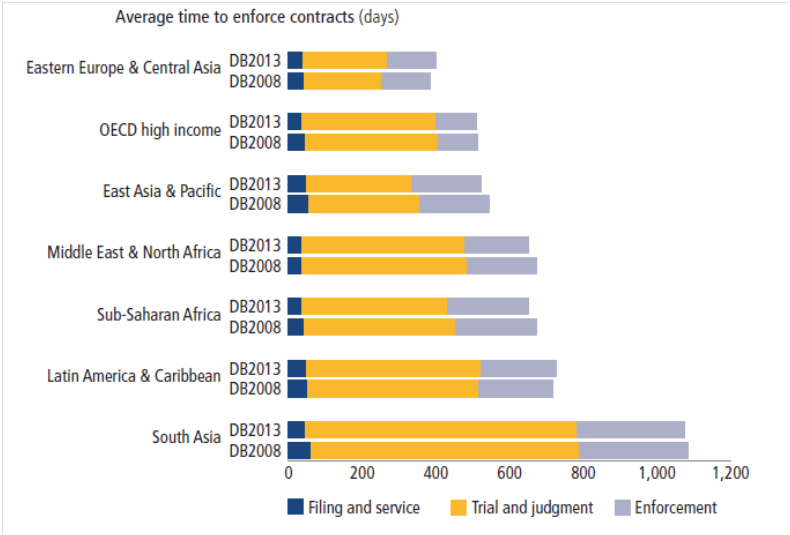
In addition to anecdotal evidence of the consequences of a slightly sluggish judiciary, empirical studies, as reported here (Doing Business – Enforcing Contracts 2013) and here, show that a judiciary that resolves commercial disputes in a timely and cost efficient manner is crucial to a healthy economy. The studies suggest that “countries with slower judicial systems, on the average, have less bank financing for new investment” and that “financial intermediates are likely to reduce the amount of lending if the ability to collect on debts is no longer given or obtaining control over property as collateral to secure loans is denied.” The latter part of the preceding sentence is evident here in Nigeria, where the consensus amongst small business owners is that it is extremely difficult to obtain affordable finance or credit from banks for their businesses.

Table culled from the Doing Business Report

Speeding up the judicial process will also be critical to resolving at least 2 current front-burner issues – corruption in government and the lack of respect for the Rule of Law. The chairman of the Economic and Financial Crimes Commission was recently reported to have expressed frustration with the ability of high profile (political/government) suspects to delay their trials. His lack of faith in the country’s judiciary is shared by the millions who would rather exact summary justice on suspected robbers or rapists than hand them over to the authorities to be investigated and charged.

Nigeria is ranked 87th out of 185 countries in ease of enforcing contracts and 8th most improved since 2005

Speedier prosecutions would lead to many positives. Wrongly accused persons would no longer waste half their lives away in police and prison cells awaiting trial. Public officials would be deterred from stealing public funds because there would be less time to manipulate (or be perceived to be manipulating the system).  The confidence of citizens in the judiciary would also be restored.

So how do we accelerate the dispensation of justice? Let us take a look at Singapore, ranked the easiest country in the world in which to enforce contracts (download data here and sort in descending order) and, coincidentally, also the best country for doing business. In this speech by one of its Justices of the Supreme Court in 2009, the history of the country’s judicial system is recounted, along with the steps taken to reform it and expedite the resolution of civil cases. To summarise, Singapore did the following:

  • Appointed more judges
  • Changed rules of court to empower courts to be more proactive in the management of cases
  • Denied adjournments
  • Gave hearing dates to moribund cases
  • Expanded jurisdiction of subordinate courts (e.g., in the Nigerian context, magistrate and customary courts) in terms of subject matter and size of monetary claims
  • Set and maintained target timelines and benchmarks, for example –
    • Seek to dispose of all cases within 18 months of filing
    • Seek to dispose of more cases than are filed every year, disposing of a number equivalent to 104% of cases filed in 2007)

In Nigeria, Lagos State is easily at the forefront of judicial reform, especially with the appointment of judges and the expansion of the jurisdiction of subordinate courts. Lagos State judges are also mandated by current civil procedure rules to encourage parties to a dispute to settle prior to a full hearing. However, courts in Lagos are still very congested, indicating that there still might not be enough judges. We are provided with an idea of what would be an acceptable ratio of judges to the population in this article on litigation and delays in the Indian judiciary. The article reports that as far back as 1987, the country’s Law Commission had recommended a ratio of 107 judges per million citizens. It is instructive that while India was planning (in 1987) to achieve this target by 2000, the USA had already achieved it in 1981. Another piece, also from India, compares India’s judges per 100,000 to the ratio in “well-administered” countries. The information is reproduced in the table below.

Country No. of Judges/100,000
USA 11
Sweden 13
China 17
Belgium 23
Germany 25
Slovenia 39
India 1.2

What, then, is the current ratio of judges to Nigerian citizens? I spent over an hour trawling through various judiciary websites and even the site of the National Statistics Bureau, with no luck finding out the number of judges (including customary court judges and magistrates) that we currently have in Nigeria. But, making assumptions, on the premises explained below, I reckon we have about 4,000 -5,000 “judges” at the very maximum.

The Supreme Court currently has fewer than 15 justices out of a constitutional maximum of 21 but let us assume a full court. There are currently roughly 70 justices of the court of the court of appeal but let us assume a bloated estimate of 100 judges for both courts. There are also roughly 70 judges of the Federal High Court. Each state has a State High Court. If we use Lagos as a benchmark, with roughly 50 judges per State (an unreasonably high estimate given that there will be several States nowhere near as busy as Lagos, but you’ll soon see where I’m going with this), that is 1850 state High Court judges for all the states and Abuja. This gives a total figure of 2,020 judges. If we then doubled the figure to accommodate judges of the National Industrial Court, judges of the customary court and the customary court of appeal, as well as magistrates, we would have an estimate of roughly 4,000. Thus, even if we assumed a figure of 5,000 judges for a population of 160 million people, the ratio is 31 judges per million individuals (or 3.1 per 100,000), approximately a third of the Indian and American ‘optimum’. The argument for more judges however, needs to be counter-balanced with the need to ensure that the integrity (not in the context of ‘honesty’ – see speech here where the former Chief Judge of Nigeria remarks that expanding the size of the Court of Appeal has led to conflicting judgements) of the system isn’t compromised or lost.

I realise that the references from which my conclusions concerning the judiciary have been drawn were primarily focused on civil proceedings but I see no reason why the same measures cannot be applied to the congestion in the criminal justice system as well. I realise too, however, that the criminal justice system also includes the police. On police reforms, I will again refer readers to the most comprehensive discussion of which I’m aware on the subject, here.

The government has taken many measures to convince foreign investors that Nigeria is a good destination for their money. The Minister of Trade has introduced accelerated the process for obtaining business visas, while the Minister of Aviation also recently announced an investment road-show. The government can give as many assurances as it wishes but it is clear that reducing the speed at which the wheels of the judiciary roll will be one of the most significant steps that will be taken.

FLYING SOLO

When I quit my old job to go into solo practice, I looked for every single piece of advice I could find, to be sure I wasn’t being foolish. There was a lot of material on the internet about “flying solo” but it was all from the UK and the USA, which is fine until you remember that many of your colleagues studied law thinking life would be like Matlock after graduation. We all realise, a little too late, that Nigerian legal practice is nothing like Matlock.

I was 6 years post-call at the time and while most colleagues, family and friends thought it was “brave” and “a good decision”, the Partners at my old job advised against it and urged me to reconsider my decision for different reasons. One thought it was premature, another suggested I would be unhappy with the type of work I would “regress” into and yet another predicted that a liquidity crunch was coming and even they were apprehensive of what the year ahead had in store for them. At the time, vanity convinced me they just didn’t want me to leave their employment but, three years later, I see that there was some objectivity in their remarks. The almighty liquidity crunch did come (seemingly to stay) and there has been significantly less M&A/Financing/transactional work than I’d anticipated/had grown accustomed to. Was my departure premature? Not really, but I see what my old boss meant.

My Constitutional Law lecturer, the late Professor JD Ojo, would frequently observe in his classes (and also in his capacity as dean of the faculty) that “the practice of law is for the rich”. We were in our late teens and early twenties at the time and reactions to the statement were varied. Prof Ojo studied for his masters and doctorate degrees at the University of London but wasn’t himself a “wealthy” man by most standards, at least not before the Abdul-Salam/Obasanjo transformation of the wages of academics. Thus, people wondered whether or not he saw the irony in his remark. Others were angry at what they perceived a condemnation to a life in penury, given their humble backgrounds. When it was made mandatory for law students to dress in monochrome with proper footwear and we all protested (at different things, including the cost of new wardrobes), Prof Ojo reminded us “without any apologies” that law is for the rich. I have come to agree with him, in a sense. I will return to this point later.

Given that I haven’t been flying solo for that long yet, is there any advice that I can give to someone considering leaving the nest? Let me try. I won’t get into marketing, networking or business development as I’m assuming every new business owner has some strategy or the other for this at the inception of their business.

1.       When is a good time to quit the old job and fly solo?

People leave big law firms for different reasons. Some are terminated and physically pushed out of the nest. Some grow tired of the monotony. Some find themselves on the cusp of an opportunity and need to be masters of their own time to effectively pursue it. Others are fed up with verbal abuse from their bosses.

It’s important to leave for the right reasons and at the right time. I think the best time to leave is when you can afford to leave: young enough to start a business and, in the event that it fails, still be young enough to be employable; if you have a family, they need to be able to remain comfortable while you find your feet; or you leave when you’re already earning so much money on the side that you’re no longer dependent on your salary (kind of like Lagos and Rivers States re federal allocations).

2.       Perseverance

Unless you’re from a wealthy family, with a wealth of ready connections to people in positions that can dispense quality work, it’s likely your stabilisation period will be fairly tough. This is probably where I agree with my old dean. It is much easier to practice law properly with a safety net(work) of family pedigree and all the perquisites that come with it. Otherwise, you need to keep plugging away at it. Persevere Until Success Happens (*kind of stolen jingo*).

3.       “Dirty Work”

There is a great deal of sleight-of-hand and smoke and mirrors out there. You keep seeing this chap who was called two years after you, yet he’s driving Range Rovers and Jaguars. If he’s not a trust-fund baby, chances are he’s a property wheeler-dealer (big ticket transactions rarely trickle down that low). Now, the purist in me hates showing people round empty houses – that’s an estate agent’s work. But there’s an opportunity cost to being a purist. And, positioning yourself to contend with bigger law firms costs money. Sometimes, therefore, you do what you have to do. Again of course, who you are, who you know and who you’ve come to know are also all very important here.

4.       Be an Authority – Be the “Go-To”

If you’re keen to practice law properly, it’s probably best to be well-renowned in your field of practice before you go solo. Yes, your Partners and the name of their firm attract the work while you’re with them but to survive after you leave them, enough of the big-paying clients had better realise that you’re the brains of the operation. That way, they may come looking for you when you leave the nest.

5.       Keep Improving Yourself/the Business

At some point, if the business doesn’t fail, work will come and you need to have the capacity to deliver at “big law” level if you want to retain the client. Capacity, both in the context of intellectual manpower and of technological hardware. You must personally be ready for that time, as must your business.

6.       Consider Staying in the Nest

The image that hardened my resolve to give self-employment a go was a 10yr+ Senior Associate almost on his knees (figuratively, at least) begging for a bonus from the Partners. And then there was the time a senior lawyer was let go without warning. But for every senior associate that carries on in an antithetical way to your ideal, for every seemingly decent lawyer let go, there are another 3 or 4 who rise through the ranks and eventually make Partner. At the end of the day, there’s no rule that says everyone must own their own law firm. Worth considering.

NB. If any other lawyer flying solo wants to add to this list, please send to rfawole@gmail.com. Contributions will receive proper attribution.

THE LAGOS-LONDON EXPRESSWAY JUST BEFORE FRANCE

Interesting things typically happen in transit on flights between London and Lagos. Tolu Ogunlesi’s recent YNaija piece reminded me of a few of my own experiences. Once, a woman who’d probably got lost in the Terminal 5 Duty Free, and on account of whom the flight had been delayed for nearly 45 minutes (they were about to take her luggage off the aircraft) finally showed up, wheeling in a humoungous holdall. Now, even if the overhead locker above her seat had been empty she would still have had trouble fitting her luggage into it. However, this was the London –Lagos flight and she was the last person to board, so the odds that it would be vacant were next to nil. Said lady, opening the locker and seeing it full, casually remarked “You Nigerians sef, is this your seat?” and proceeded to toss all the other bags on the floor. Of course, pandemonium ensued.

The incident after which this piece is titled is no less remarkable for its shock-factor. We were well into the British Airways flight, dinner had been served and cleared, alcoholics had had their nightcaps and passengers were falling asleep on their second or third movies. The lights had long since been dimmed and we were nearing the end of the silence just before the flurry of activity that usually precedes landing; that point when the flight map shows the aeroplane somewhere between Morocco (?) and France. Suddenly, three sharp slaps rent the air, thwap, thwapp, thwapp! “You thief!” the slapper accused.

Going by standard fare in Nigerian comedy circles, the recipient of the slaps must have been a Yoruba man, as the final syllables of all the exclamations that followed left him with his mouth wide open.

“Ha! Ha! Haaa! You slapped me? Me, you slapped me?? I will kill this old woman o!” he screamed. He spread his fingers wide and raised his arm in a pre-slap arc. A gentleman sitting in the row behind them quickly grabbed him mid-swing. “Control yassef” he urged the incandescent man, “are you not a man?”

“You stole my money,” the middle-aged lady alleged.

“Me???!! Steal money from you??? I have three thousand pounds in my brief-case!” as he lunged for her again. But the intervener refused to let go. “You’re a man. Control yassef. Control yassef,” he urged.

By this time, the BA flight attendants had run over in military formation and asked the man to come four rows back, to the rear of the plane, two seats away from me. A male attendant remained with the woman, while the person interviewing the alleged thief was female.

“Did you take her money sir?” the attendant asked. The man, in his late 30s to early 40s, started denying very loudly but she insisted he calmed down before answering. The man, still upset, very firmly refuted the accusation. The male attendant came over very shortly afterwards and asked to confer with his female colleague in the galley. They soon emerged, with female attendant looking slightly embarrassed.

“Ok sir, Let me first of all apologise for what just happened. My colleague has spoken with the passenger beside you. She’s now said she’d been dreaming that someone’s hand was inside her purse and suddenly woke up… I’m really, really sorry sir…we’ll also have to ask you to remain here at this seat until we land at Heathrow… I’m so, so sorry, sir.”

The man was silent for a few seconds, appearing to contemplate the misfortune that had just befallen him. Then, with absolutely no warning, he burst into tears and cried thoroughly, bitterly, broken-heartedly for a good five to ten minutes.

MY DISAGREEMENT WITH THE “Mob Justice” BILL

In the wake of the gruesome extrajudicial murder of the four young men who have since come to be known as the “Aluu4”, author Okechukwu Ofili drafted a bill against mob justice and began an online campaign to support the passage of the bill into law. As the act of a concerned citizen not merely contented with wringing his hands and lamenting the abyss that Nigeria is inching towards, it is an act that must be commended. However, if we put the good intentions of Mr Ofili and his supporters aside and examine the substance of the petition and the bill itself, we will find that it actually isn’t as punchy as its enthusiasts believe.

The petition begins with the misconception that mob justice is not a crime in Nigeria. Several tweets were sent out along the lines of “[Counterfeiting stamps] is an offence in Nigeria but mob justice isn’t. Sign the petition and say ‘Never Again’ to mob justice!” I say ‘misconception’ because there is absolutely nothing about “mob justice” (or ochlocracy, as Teju Cole explains) that is legal, even in the international backwater that we frequently agree is Nigeria. After all, mob justice is the colloquial term given to the actions of a group of people taking laws into their own hands and assuming the positions of judge, jury and executioner over persons suspected of committing a crime.

What are the acts that constitute “mob justice”? Typically, the Nigerian “mob” sets on the suspects, strips them naked, beats them senseless and very often murders them by setting them on fire. To say that mob justice is not a crime is to suggest that each of these heinous acts is perfectly legal. Clearly, this position is absolutely untenable.

Before we even venture into the Criminal Code, let us examine the supreme legal document in the land – the 1999 Constitution. Chapter IV of the constitution states the fundamental rights of each and every Nigerian citizen.

Section 33(1) tells us that “[E]very person has a right to life and no one shall be deprived intentionally of his life, save in execution of the sentence of a court in respect of a criminal offence of which he has been found guilty in Nigeria.” Section 34(1)(a) says “Every individual is entitled to respect for the dignity of his person, and accordingly no person shall be subjected to torture or to inhuman and degrading treatment.” Section 36 guarantees the right to “a fair hearing within a reasonable time by a court or other tribunal established by law and constituted in such manner as to secure its independence and impartiality.”

It is clear that nothing that happened in Aluu is “not a crime in Nigeria”, going by the Constitution.

But what about the Criminal Code? Section 315 provides that “[A]ny person who unlawfully kills another is guilty of an offence which is called murder or manslaughter, according to the circumstances of the case.” Sections 351-356 clearly state what constitutes assault. Chapter 54 tells us that it is a criminal offence to conspire with other persons to commit a crime. Grievous harm (i.e. “ bodily hurt which seriously or permanently injures health, or which is likely so to injure health, or which extends to permanent disfigurement or to any permanent or serious injury to any external or internal organ, member, or sense)is also an offence under the criminal code. On the parties to an offence, Section 7 of the Criminal Code is very clear and I reproduce the pertinent part below:

“When an offence is committed, each of the following persons is deemed to have taken part in committing the offence and to be guilty of the offence, and may be charged with actually committing it, that is to say-

(a) every person who actually does the act or makes the omission which constitutes the offence;

(b) every person who does or omits to do any act for the purpose of enabling or aiding another person to commit the offence;

(c) every person who aids another person in committing the offence;

(d) any person who counsels or procures any other person to commit the offence.”

It is therefore also clear that nothing that happened in Aluu is “not a crime in Nigeria”, going by the Criminal Code. Not even standing by or cheering on the murderers.

For me, therefore, the entire campaign was based on an entirely false premise. I was unable to bring myself to retweet or advocate for support for it. The truth is that the so-called “Mob Justice Bill” does not and will not change the law. Mob justice is already illegal. If it wasn’t, there would be no basis for charging the persons who have now been arraigned for the crime that was committed in Aluu.

Is there a bigger implication for social media advocacy? Yes. We cannot sit on our technological high horses and accuse the government of profligacy or inefficiency and engage in conduct that encourages the very same things. If we intend to be taken seriously at the very highest levels, we need to ensure that our actions are not only sentimentally sound but that they are also valid under the rule of law.

There is even a more potentially dangerous side of which we must all be aware. In law school, we are taught that criminal law is the easiest aspect of law for newly qualified lawyers to get into. This is because offences are broken down into separate components and once a lawyer can show that even one component of, say, a five component offence is absent, his client walks. Laws that would create crimes must be mindful of this “flip side”.

Again, we must separate the intentions of the “Mob Justice Bill” advocates from the obviously unintended outcome of their actions. We cannot deny that the Bill was borne out of the desire to make a change and the intention of the promoters of the Bill should be acknowledged.

Finally, does this piece mean that we should all sit down in our comfort zones and do nothing about unlawful killings and extrajudicial justice? By no means. Like most things that are fundamentally wrong with Nigeria, strengthening [democratic and judicial] institutions is the key to progress. The faith of the common man in the justice system must be restored. To achieve this, there must be police and judicial reform. Extensive work has already been done on a framework for the reform of the Nigerian police and can be found here. Turnaround time must be reduced in the judiciary and advocacy that would achieve an end to mob justice would be better channelled, in my opinion, along these lines.

RF (@TexTheLaw)

WHAT IS THIS RULE OF LAW?

Jurisprudence, in spite of the trepidation in which law students typically hold it, like my undergrad philosophy electives, was a truly fascinating course for me. I marvelled at how regular human beings like us devoted their time to critical thinking to develop ideas that would develop their countries and, unknown to them at the time, shape global appreciation of ideas of law and the state. The notion of the rule of law came about as a result of the exertions of these early thinkers.


When the late Umar Musa Yar’Adua assumed office in 2007, he committed his administration to observing and enshrining the rule of law. The phrase became a mantra during his tenure and especially gained popularity when, unlike his predecessors in office, he immediately ordered security agencies to enforce decisions of election tribunals that delivered adverse rulings against his party. While this was widely celebrated, it led to ‘the rule of law’ becoming synonymous with the government ‘permitting’ adverse tribunal rulings to stand.


The rule of law has since become a one-eyed, one-armed and one-legged invalid. Business has carried on as usual, the occasional motorist reportedly continued to be shot by the police for refusing to part with ‘special tolls’ at check-points until they were recently dismantled, high-profile criminal trials go a less-than-usual way, many agencies exceed the scope of their jurisdiction but as long as election tribunal judgements are respected, rule of law watchers continue to give the country a pass mark.


So, what did the original framers of the expression mean? More than a meaning, the rule of law is a concept of many parts – no one is above the law; no one can be punished by the state except for a breach of the law and in accordance with the law; agreements must be kept; no branch of government is above the law; no public official may act unilaterally or arbitrarily outside the law. It means the law, with all its constituent procedures, is (or at the very least, should be) supreme.


The law is clearly yet to be supreme in Nigeria. It should be impossible for parties, including the government, to unilaterally cancel contracts but this is still complained about fairly regularly. Supremacy of the law should mean that accused persons do not spend three years in detention awaiting trial. It should mean, as well, that powerful politicians and government appointees, no matter how highly placed, obey all administrative and judicial orders; seeking orders from the courts to restrain law enforcement agencies from carrying out their statutory and constitutional functions should be thoroughly decried. It should also mean that the law is predictable and any changes to it are not done haphazardly – unlike here in Nigeria where “laws” or regulations change on the whim of the administrative officer in charge, without notice to the public or actual publication and gazetting the new regulations (see a previous post on that here).


The rule of law being supreme also means, however, with relevance to recent events that the law is allowed to take its due course. Currently, the public is baying for the blood of everyone indicted in the report of the Ad Hoc Committee (of the House of Representatives) on the administration of fuel subsidy in Nigeria. Everyone is frustrated at the Attorney-General’s suggestion that prosecutions cannot commence straightaway. The truth, however, is that the proper procedure is for the House to forward its conclusions to the police and other relevant law-enforcement agencies for further investigation. As things stand, if charges are brought based on the House report alone, every single person “fingered” WILL be acquitted. The investigative bodies must be given time to compile evidence on which convictions can be obtained safely (ie that appellate courts will be hard pressed to find grounds for reversal). The court of public opinion and the courts of law are two entirely different propositions and while many “criminals” have been convicted largely on hearsay in the former, securing convictions in the latter is a more technical, more skilled, endeavour.


Thus, while it is entirely proper for the public to expect prosecutions it is important that we do not, in our frenzied frustrations with the status quo do more damage than good. The true test of how supreme a belief or concept is held is adherence to it even when doing so is not to one’s immediate advantage. If it is the consensus that upholding the rule of law is integral to our country’s prosperity, we cannot make exceptions for when it should be applied.