THE LAGOS-LONDON EXPRESSWAY JUST BEFORE FRANCE

Interesting things typically happen in transit on flights between London and Lagos. Tolu Ogunlesi’s recent YNaija piece reminded me of a few of my own experiences. Once, a woman who’d probably got lost in the Terminal 5 Duty Free, and on account of whom the flight had been delayed for nearly 45 minutes (they were about to take her luggage off the aircraft) finally showed up, wheeling in a humoungous holdall. Now, even if the overhead locker above her seat had been empty she would still have had trouble fitting her luggage into it. However, this was the London –Lagos flight and she was the last person to board, so the odds that it would be vacant were next to nil. Said lady, opening the locker and seeing it full, casually remarked “You Nigerians sef, is this your seat?” and proceeded to toss all the other bags on the floor. Of course, pandemonium ensued.

The incident after which this piece is titled is no less remarkable for its shock-factor. We were well into the British Airways flight, dinner had been served and cleared, alcoholics had had their nightcaps and passengers were falling asleep on their second or third movies. The lights had long since been dimmed and we were nearing the end of the silence just before the flurry of activity that usually precedes landing; that point when the flight map shows the aeroplane somewhere between Morocco (?) and France. Suddenly, three sharp slaps rent the air, thwap, thwapp, thwapp! “You thief!” the slapper accused.

Going by standard fare in Nigerian comedy circles, the recipient of the slaps must have been a Yoruba man, as the final syllables of all the exclamations that followed left him with his mouth wide open.

“Ha! Ha! Haaa! You slapped me? Me, you slapped me?? I will kill this old woman o!” he screamed. He spread his fingers wide and raised his arm in a pre-slap arc. A gentleman sitting in the row behind them quickly grabbed him mid-swing. “Control yassef” he urged the incandescent man, “are you not a man?”

“You stole my money,” the middle-aged lady alleged.

“Me???!! Steal money from you??? I have three thousand pounds in my brief-case!” as he lunged for her again. But the intervener refused to let go. “You’re a man. Control yassef. Control yassef,” he urged.

By this time, the BA flight attendants had run over in military formation and asked the man to come four rows back, to the rear of the plane, two seats away from me. A male attendant remained with the woman, while the person interviewing the alleged thief was female.

“Did you take her money sir?” the attendant asked. The man, in his late 30s to early 40s, started denying very loudly but she insisted he calmed down before answering. The man, still upset, very firmly refuted the accusation. The male attendant came over very shortly afterwards and asked to confer with his female colleague in the galley. They soon emerged, with female attendant looking slightly embarrassed.

“Ok sir, Let me first of all apologise for what just happened. My colleague has spoken with the passenger beside you. She’s now said she’d been dreaming that someone’s hand was inside her purse and suddenly woke up… I’m really, really sorry sir…we’ll also have to ask you to remain here at this seat until we land at Heathrow… I’m so, so sorry, sir.”

The man was silent for a few seconds, appearing to contemplate the misfortune that had just befallen him. Then, with absolutely no warning, he burst into tears and cried thoroughly, bitterly, broken-heartedly for a good five to ten minutes.

MY DISAGREEMENT WITH THE “Mob Justice” BILL

In the wake of the gruesome extrajudicial murder of the four young men who have since come to be known as the “Aluu4”, author Okechukwu Ofili drafted a bill against mob justice and began an online campaign to support the passage of the bill into law. As the act of a concerned citizen not merely contented with wringing his hands and lamenting the abyss that Nigeria is inching towards, it is an act that must be commended. However, if we put the good intentions of Mr Ofili and his supporters aside and examine the substance of the petition and the bill itself, we will find that it actually isn’t as punchy as its enthusiasts believe.

The petition begins with the misconception that mob justice is not a crime in Nigeria. Several tweets were sent out along the lines of “[Counterfeiting stamps] is an offence in Nigeria but mob justice isn’t. Sign the petition and say ‘Never Again’ to mob justice!” I say ‘misconception’ because there is absolutely nothing about “mob justice” (or ochlocracy, as Teju Cole explains) that is legal, even in the international backwater that we frequently agree is Nigeria. After all, mob justice is the colloquial term given to the actions of a group of people taking laws into their own hands and assuming the positions of judge, jury and executioner over persons suspected of committing a crime.

What are the acts that constitute “mob justice”? Typically, the Nigerian “mob” sets on the suspects, strips them naked, beats them senseless and very often murders them by setting them on fire. To say that mob justice is not a crime is to suggest that each of these heinous acts is perfectly legal. Clearly, this position is absolutely untenable.

Before we even venture into the Criminal Code, let us examine the supreme legal document in the land – the 1999 Constitution. Chapter IV of the constitution states the fundamental rights of each and every Nigerian citizen.

Section 33(1) tells us that “[E]very person has a right to life and no one shall be deprived intentionally of his life, save in execution of the sentence of a court in respect of a criminal offence of which he has been found guilty in Nigeria.” Section 34(1)(a) says “Every individual is entitled to respect for the dignity of his person, and accordingly no person shall be subjected to torture or to inhuman and degrading treatment.” Section 36 guarantees the right to “a fair hearing within a reasonable time by a court or other tribunal established by law and constituted in such manner as to secure its independence and impartiality.”

It is clear that nothing that happened in Aluu is “not a crime in Nigeria”, going by the Constitution.

But what about the Criminal Code? Section 315 provides that “[A]ny person who unlawfully kills another is guilty of an offence which is called murder or manslaughter, according to the circumstances of the case.” Sections 351-356 clearly state what constitutes assault. Chapter 54 tells us that it is a criminal offence to conspire with other persons to commit a crime. Grievous harm (i.e. “ bodily hurt which seriously or permanently injures health, or which is likely so to injure health, or which extends to permanent disfigurement or to any permanent or serious injury to any external or internal organ, member, or sense)is also an offence under the criminal code. On the parties to an offence, Section 7 of the Criminal Code is very clear and I reproduce the pertinent part below:

“When an offence is committed, each of the following persons is deemed to have taken part in committing the offence and to be guilty of the offence, and may be charged with actually committing it, that is to say-

(a) every person who actually does the act or makes the omission which constitutes the offence;

(b) every person who does or omits to do any act for the purpose of enabling or aiding another person to commit the offence;

(c) every person who aids another person in committing the offence;

(d) any person who counsels or procures any other person to commit the offence.”

It is therefore also clear that nothing that happened in Aluu is “not a crime in Nigeria”, going by the Criminal Code. Not even standing by or cheering on the murderers.

For me, therefore, the entire campaign was based on an entirely false premise. I was unable to bring myself to retweet or advocate for support for it. The truth is that the so-called “Mob Justice Bill” does not and will not change the law. Mob justice is already illegal. If it wasn’t, there would be no basis for charging the persons who have now been arraigned for the crime that was committed in Aluu.

Is there a bigger implication for social media advocacy? Yes. We cannot sit on our technological high horses and accuse the government of profligacy or inefficiency and engage in conduct that encourages the very same things. If we intend to be taken seriously at the very highest levels, we need to ensure that our actions are not only sentimentally sound but that they are also valid under the rule of law.

There is even a more potentially dangerous side of which we must all be aware. In law school, we are taught that criminal law is the easiest aspect of law for newly qualified lawyers to get into. This is because offences are broken down into separate components and once a lawyer can show that even one component of, say, a five component offence is absent, his client walks. Laws that would create crimes must be mindful of this “flip side”.

Again, we must separate the intentions of the “Mob Justice Bill” advocates from the obviously unintended outcome of their actions. We cannot deny that the Bill was borne out of the desire to make a change and the intention of the promoters of the Bill should be acknowledged.

Finally, does this piece mean that we should all sit down in our comfort zones and do nothing about unlawful killings and extrajudicial justice? By no means. Like most things that are fundamentally wrong with Nigeria, strengthening [democratic and judicial] institutions is the key to progress. The faith of the common man in the justice system must be restored. To achieve this, there must be police and judicial reform. Extensive work has already been done on a framework for the reform of the Nigerian police and can be found here. Turnaround time must be reduced in the judiciary and advocacy that would achieve an end to mob justice would be better channelled, in my opinion, along these lines.

RF (@TexTheLaw)

This Logic Matter

They say the mark of having had a fulfilling time in the university is that not only do you pass through the university but it also passes through you. I’ve never quite been sure if that expression is anything besides a fluffy Nigerianism but, if the university passing through you means that some of the things you learnt remoulded you and will stay with you forever, then logic (aka Philosophy 102 – Arguments and Critical Thinking) really passed through me. Mr. Owolabi, God bless him and his crutch, would frequently say “Let’s do what they’re incapable of doing in Aso Rock; let’s think!”

That elective has probably gotten me into the most trouble with my wife since we met. For some inexplicable reason, I would rather logic prevailed over intuition even though I know full well that life is more than inductive and deductive reasoning. When trying to interpret other people’s actions, more often than not, I use my logic filter. Mrs Tex (whether or not it’s because she’s a woman and therefore more likely to be more intuitive anyway) doesn’t have this ‘handicap’ and over the years my logic has prevailed over her intuition only 1 out of 5 times on the average. Which makes my devotion to it increasingly infuriating for her.

So maybe not everything in life can be subjected to the rigour of testing the validity of the thinking behind them. However, the greatest thinkers of any generation, and their critics and disciples, have no other means of establishing or disputing the authority of their ideas. No meaningful discussion can be had otherwise.  If you want your conclusions to be accepted, you need to give valid, logical, reasons why. It is therefore somewhat sad, for example, to read rejoinders to articles and opinions that, rather than discussing the original issues raised are nothing more than attacks on the person of the original writer. Or, on the comment threads of some online articles, to find an opinion roundly criticised only on the basis that it was expressed by someone from a certain tribe.

Clearly, we are products of our environment and sentiments and bias will have some bearing on the attitudes we adopt and ideas we express. And that’s probably acceptable for private discussions. When ideas are being propounded for public consumption though, I believe logic must relegate sentiments, intuition and bias. I may be wrong but I am convinced that until we elevate the way we discuss issues (and actually discuss issues), especially those of us outside the “cabal” crying for change, we may find progress elusive.

Below are a few examples of prevalent thinking (from the educated segment of our society) – they should give us pause:

  • El-Rufai is only criticising the government because his own party lost the elections [has he raised valid issues?]
  • Kathleen doesn’t support the doctors’ strike because she wanted to marry a doctor but failed to [has she given valid reasons why they shouldn’t have gone on strike?]
  • We know Ijeoma’s antecedents in XYZ corporation, how can she castigate us? [are you guilty of the allegations she has levelled against you, though?]
  • I couldn’t have orchestrated fraud because I actually taught at Harvard [yes, we all know Harvard is next to the Vatican in preparing people for priesthood and sainthood]
  • We’re revoking the contract because it was skewed in favour of the concessionaire [I killed my parents but you should have mercy on me because I’m now an orphan]
  • You’re a foreigner; Nigeria’s issues should only be discussed by Nigerians [Boko Haram issues should only be discussed by terrorism experts too, right?]
  • This kind of backward, myopic (etc) thinking can only be found in the [pick your choice] tribe [and everyone is a genius where you come from? Even that your uncle that the entire family mocks?]
  • Do you know who I am? [If Obama, Putin, Cameron and Merkel jointly put forward a stupid idea, it’s STILL a stupid idea!]

On a lighter note, logic served my friends and I very well at Sade Eleja. There was always someone willing to buy us another round of drinks and catfish peppersoup to prevent us from leaving early. “Mo n gbadun yin gan an…”

Beware the Roads of Lagos

Heegnoranz” can certainly not be “hegscuze” for anyone that falls prey (metaphor intended) to the new traffic law of Lagos State. It has been so well-publicised that one hopes this manner of publicity will follow documents of accountability of the government. The law is available for download here, in case anyone’s still looking for a copy.


I have suggested elsewhere that draconian laws may be the drastic measure needed to get us back in line but, given LASTMA’s penchant for sacrificing the spirit of the law on the altar of its letter and the 1000% increase in applicable fines (in many instances), I may very well rue my words.


So what does the law do? No, it doesn’t ban eating or drinking while driving, at least not specifically (closest I came across was “counting money or otherwise engaged in other activities when driving”). It does however, like its sister Act (*chuckles*) the LASTMA Law of 2004, prohibit smoking while driving. I have set out a table below, comparing some of the old offences and penalties with the newer version. You should probably skip down there if you want to avoid the boring legalese that follows.


The consensus on the law is that the punishments appear to go too far. Apart from this, I think it short on the definitions of some offences. For instance, a driver is liable upon conviction for dangerous driving, to a fine of N100,000 and/or two years’ imprisonment. An offence with such a hefty penalty should not be left solely to the discretion of the LASTMA of today. (See the UK Road Traffic Act and its definition of dangerous driving).


Section 20, on “careless and inconsiderate driving” also throws another curve ball. Subsection (2) appears to give the court the power to direct the accused driver to be charged with a different charge if the court is of the opinion that the original charge has not been proved. This would appear to go contrary to the long-establisheddouble jeopardy rule in criminal law. Apart from being a principle of common law, “double jeopardy” is also prohibited by section 36(9) of the constitution, which reads-

“No person who shows that he has been tried by any court of competent jurisdiction or tribunal for a criminal offence and either convicted or acquitted shall again be tried for that offence or for a criminal offence having the same ingredients as that offence save upon the order of a superior court.”


Driving under the influence of drugs or alcohol is rightly prohibited but, while the law gives LASTMA the power to test blood and urine, no maximum limit is stipulated. You may be charged with this offence if it seems to the LASTMA official that the extent of your inebriation is such that you are “incapable of having proper control of the vehicle.” This sounds reasonable enough but in actual fact, it leaves all the power in the traffic authority’s hands.


There is a fine for abandonment of vehicles. There is a related fine for failing to notify the police or LASTMA that a vehicle has been abandoned near your premises. The law doesn’t tell us what constitutes abandonment, however. If my car breaks down and I have to leave it by the roadside until my mechanic is available, after how long can it be deemed “abandoned”? 12 hours? 24 hours? 48 hours? Whatever LASTMA feels constitutes abandonment?


The motorcycle-related provisions of the law also appear to apply to ALL motorcycles. No distinction is made between private and commercial motorcycles. Thus, technically, LASTMA could arrest a sports bike (“power bike”) rider for being on a route on which motorcyclists have been banned (see page 29 of the law). It must be pointed out that the new restrictions on motorcycle traffic (permits, maximum number of passengers, etc) seem quite sound, however.


It is also an offence for your vehicle to break down on the road and cause an obstruction to traffic. No, that’s not a typo. And you’d be fined N50,000 and still have to pay the cost of towing, Would it not be more reasonable for the State to provide free recovery services to a non-obstructive point, like LCC does on the Lekki-Epe expressway (I don’t believe I just paid LCC a compliment!)?


The question remains though, as to why the fines have been increased so dramatically. Many of these offences already existed, suggesting that a lack of enforcement (and not the mildness of penalties) is the reason why traffic remains chaotic in Lagos. Are the enormous fines a stealth tax or fund-raising initiative?  It would have also helped the considerably large smoker population if the policy behind banning smoking was properly articulated (even though this offence was listed in the 2004 law). Lagos would seem to be the first city in the world to impose such a ban. Perhaps the purpose of the law is even to reduce traffic by making Lagosians too frightened to drive.


In any event, safer driving will ultimately be a good thing and one earnestly hopes that LASTMA and the VIO will adopt a common-sense, non-predatory approach to the enforcement of the new regulations.

Be safe, everyone!


TABLE OF [SELECTED] TRAFFIC VIOLATIONS & PENALTIES

2004 provisions are in black; 2012 are in red


VIOLATION

PENALTY
POINT FINE

N

ADDITIONAL
Driving without a valid Driver’s Licence 2/2 2,000/[no fine stated] Impound Vehicle/payment for removal and storage and evidence of payment for the licence.
Learning to drive on a major highway 3/2 2,000/1st Offender N20,000; subsequent offender N30,000 Dislodge Driver/ payment for removal and storage and evidence of payment for the licence.
Driving with fake number plates 4/4 4,000/1st Offender N20,000; subsequent offender N30,000 Impound Vehicle/imprisonment of 3 years or both fine and imprisonment
Driving a vehicle with unauthorised or defective reflective number plate 2/2 2,000/1st Offender N20,000; subsequent offender N30,000 Impound Vehicle/imprisonment of 3 years or both fine and imprisonment
Driving without a valid MOT Test Certificate 2   Impound Vehicle/payment for removal and storage and evidence of payment for the certificate.
Driving without a valid roadworthiness certificate 2   Impound Vehicle/payment for removal and storage and evidence of payment for the certificate.
       
Violation of route by commercial vehicle 2/2 2,000/ 1st Offender N20,000; subsequent offender N30,000
       
Disobeying traffic control personnel or traffic signs 1/2 2,000/1st Offender N20,000; subsequent offender N30,000
Disobeying traffic lights 4 5,000  
Failure to yield to right of way of pedestrians at a zebra crossing 4/3 5,000/ 1st Offender N20,000; subsequent offender N30,000  
Failure to give way to traffic on the left at a roundabout 2/2 2,500/ 1st Offender N20,000; subsequent offender N30,000  
       
Driving under the influence of alcohol and/or drugs 2 2,000/N100,000 or 2 years imprisonment or both Impound Vehicle
Smoking while driving 1/2 2,000/ 1st Offender N20,000; subsequent offender N30,000  
       
Tailgating an emergency vehicle 4/3 5,000/1st Offender N20,000; subsequent offender N30,000  
Failure of slow-moving vehicle to keep to the right lane 2/2 2,500/1st Offender N20,000; subsequent offender N30,000  
       
Assault on a Traffic Officer(physical) 4 5,000/[no fine stated] Prosecute in court/Imprisonment for a term of three (3) years or both fine and imprisonment
Driving in a direction prohibited by the Road Traffic Law [i.e. “one-way”]/Neglect of traffic directions 4 25,000/[forfeiture of vehicle to the state] Impound/ 1st Offender – one (1) year imprisonment and forfeiture of the vehicle to the State; 2nd and subsequent offender (3) years imprisonment and forfeiture of the vehicle to the state; offenders to have data and biometrics captured.
Bullion vehicle driving in a direction prohibited by the Road Traffic Law 4/5 50,000/ [Forfeiture of vehicle] Impound/Imprisonment for a term of three (3) years, or both fine and imprisonment
Illegal U-Turns 2/3 2,000/ 1st Offender N20,000; subsequent offender N30,000 Driver Training
Making or receiving phone calls when driving 2/2 2,500/1st Offender N20,000; subsequent offender N30,000  
Counting money, or [being] otherwise engaged in other activities when driving 2 1st Offender N20,000; subsequent offender N30,000  
Failure to display reflective warning triangle sign [i.e. “C-Caution”] at point of breakdown 4 10,000  
Causing obstruction on highway if broken down 2 N50,000.00; cost of towing

TEX’S ADVENTURES IN WONDERLAND

I have just returned to Nigeria after the longest holiday of my life (not counting the ASUU-induced ones). Three weeks of relaxation and de-stressing in two #ThisIsACountry countries. No generators to fuel or put on, sanity on the roads, round-the-clock electricity, no one worried that the witches in his mother’s village were jinxing him. It was truly a pleasant time away. I’m back now and, in addition to the needing to provide my own electricity, the fuel queues and police checkpoints are back. Anyway, here are some stories from my summer wonderland.


Passport Renewals

My Texinas are dual-nationals and one of them needed to have her Wonderland passport renewed while we were away. I’d filled the application form online before we got there and chose the one-day express walk-in renewal service for a date two days or so after our arrival. All the Wonderland folks required for the renewal were her old passport and birth-certificate. We spent less than 10 minutes with the document-checker and less than 30 overall including going through security and getting a ticket number. “Come back at 5 for the passport”, we were told. I kept waiting for her to ask me for her “something for the weekend” but she didn’t. Got back at 5.30, the passport was ready. Simples.


At the Ikoyi passport office, even after you’ve paid the tout for “express” service, you still have to endure a 1-hour inter-religious prayer session with the 300 or so other applicants under the waiting canopy. “These passports you are collecting today, the Lord will never allow foreign embassies to stamp refusals or rejections on them.” “AMEEEEEN”, the people chorus back…


Then someone yells out applicants names from a pile of labelled files stacked on the table. Every applicant called must then collect his file from the yeller and personally take it into the processing room. In the processing room, someone checks the documents in the file and signs something which you need to quickly dash out to photocopy, then somebody shows you your data on the screen for your approval, warning you that mistakes cannot be corrected after this point. Then another person takes your picture. Long story short, four hours and two weeks after you arrive, your passport should be ready. If you didn’t pay a tout though, I bet you’re still under that waiting canopy, earnestly expecting the yelling immigration guy to call out your name.


The Lord’s Army

Still on the Texinas, I’m a firm believer in the importance of children growing up listening to wholesome music. This is mostly because I did and, every once in a while, a nice melody from primary school bursts into my consciousness and I have a nice bask in the nostalgic waterfall. I therefore have loads of music from CBBs and Disney and this is what we listen to in the car on family outings. None of all that nanananinanaininono stuff. I decided to add nice children’s Christian music to the mix in Wonderland and got a CD named ‘Action Bible Songs’. One of the songs on this album is ‘The Lord’s Army’, which most of us learned at Sunday School, way back. You know, “…for I am in the Lord’s Army. Yessir!!” yes, that one.


Now here’s a teaser for you. Do you know the actual words of the verse? Chances are, like me, you’ve been singing “I will never whoomp on the enemy, grunt on the nanini, ride on the fillary…” No, you’re not like me? Well, thanks to this CD, I now know that the real words are –

                I may never march in the infantry/Ride in the cavalry/Shoot the artillery/I may never zoom o’er the enemy/But I am in the Lord’s Army


The sound of all those pennies dropping. You’re welcome.


Dinner with the Cabal

I informed His Royal Overlordness King Feyi XVIII (@doubleeph) that I would be in his neck of the Wonderland Woods and he very graciously invited me for an evening of Roast Pheasant and Arcanian Cheese with Akin Oyebode (@AO1379), Dapo Adesanya (@DapoAdesanya) and [Uncle] Akin Akintayo (@forakin).


Okay, so it wasn’t really pheasant and cheese but it was an extremely pleasant Wonderland evening at a restaurant owned by one of the truly great Nigerian musicians of yore. Now, I have the habit of imagining what people I’ve never met sound like, from their appearance in pictures. @AO1379 is a regular contributor on ynaija and the voice I’d made up for him in my head would’ve made Barry White jealous. He wasn’t that baritone but he is a great ‘conversator’. Plus, contrary to what I think he’s said before on the twitter, he paid for non-1759 drinks, so hearty cheers to him.


You may have noticed that I referred to @forakin as ‘Uncle’. This is because in the middle of one of his stories (in his ever so posh manner) he mentioned the year in which he finished secondary school. The rest of us at the table did double-takes, remembering how old (or more correctly, young) we were at the time.


A nice evening of great conversation and made in Wonderland Nigerian food.


LCC Bollocks

When LCC announced the arrival of electronic tags for users of their toll road, I promptly took the papers of mine and Mrs Tex’s cars to register for the e-Tag. Unfortunately for all concerned, Mrs Tex’s car was still registered in her maiden name (“You need to bring the marriage certificate…”) and mine was still registered in the name of the leasing company (“…and a letter from this company on the papers.”).

“But it’s my bank account that I would be linking the tags to.” I protest.

“No o, Oga. It haff serious legal implication.”

“Really? Someone will sue LCC for letting me pay for e-Tag on their car?”[raised eyebrow]

“Hehe. Oga, it seems like you don’t understand what I’m saying. It haff legal [read “legggal”] implication.”


Of course, I wasn’t going to bring a marriage certificate to get a sodding e-Tag and that was that.


In Wonderland, in the Baltimore-Washington DC axis, you will find 2 short parallel Velcro stickers on most people’s car windshields. Johnny Just Come (Johnny Come Lately, in proper English) initially prevented me from asking what they were for but I found out soon enough. On this same commuting axis, you see, are a couple of toll roads. The LCC in Wonderland also have e-Tag equivalents called EZ Passes. The Velcro stickers are how you affix your EZ Pass onto your windshield to pay tolls. Drivers transfer EZ Passes between vehicles; that being the reason why in many cars you’d see the bare Velcro stickers but no EZ Pass. No legggal issues whatsoever in a #ThisIsACountry country.


Returning From Wonderland

As a great sage recently informed us, everything that has a beginning must have an ending. On this, he was right and I eventually found myself in the MMIA  – the land of “What do you have for us?” Typically at MMIA, you’re on the immigration queue for about 30 minutes and spend the next hour and a half gathering your luggage (unless you flew First or Business Class). If, as frequently happens, the baggage carousel breaks down and luggage has to be transferred to another carousel your wait could be much longer.


However, on the day I returned from Wonderland, Immigration fast-tracked us on the queue because of the Texinas, so our passports were stamped roughly 10 minutes after disembarking from the plane. While waiting for the usual “so, oga lawyer, what did you bring for us?” from the immigration fellas, I spied a carousel churning out luggage. I didn’t think, in a million years, it could be for our flight but was I glad to be wrong. Another 30 minutes and all our luggage had been collected. Now for the customs people.


I was bracing myself for “What’s in the boxes? Open one, let’s see. Okay don’t open, just find something for us and you can go.” But the lady just pointed out to us that exits had changed because of ongoing renovation and that we were to head in a different direction. Hang on, I thought, isn’t this a #ThisIsNotACountry HQ? Right on cue, probably just to make sure I wasn’t permanently disorientated, PHCN struck and there was a power cut, accompanied by that usual groan that people make when that happens. The lights soon came back on and, as I left the terminal, I heard a different customs officer remark to an expatriate grabbing the last of his baggage, “Welcome to Nigeria.”


Indeed, I thought.


Of Bullies and The Fickle

In our country, there is a customary acclamation that follows the writings of some people, regardless of the depth (or otherwise) of their summations. Such writers are usually either people who have paid their dues in theie profession (or the public eye) and whose reputation therefore precedes their publications; or they are people who generally produce populist material (populism, of course, isn’t necessarily a bad thing but that’s probably a discussion for another day). I think that in Chief Dele Momodu, we may have a combination of both. The good Chief’s most recent piece on the “bully” that is the Central Bank Governor, in my opinion, fully supports my belief.

The article starts with the propositions that Mallam Sanusi is a poor student of history and that Nigerians are fickle (these may very well be so, but that is not my grouse with his piece). He proceeds to recount Nigeria’s political upheaval from Shehu Shagari to the second incarnation of the Obasanjo presidency, to illustrate how today’s political darling is tomorrow’s scorned lover. Thereafter, the article places Mallam Sanusi firmly in its cross-hairs and fires salvo after salvo at Sanusi’s character, with absolutely no effort made at any analysis of the policies being decried.

According to Chief Momodu, Sanusi is all of the following – lord of a fiefdom, a reckless spender [on outlandish projects], academically brilliant but unbridedly radical, someone who does things in the extreme and lacks the tolerance to persuade others, a loose canon, a sword of Damocles against his foes, vainglorious, rabblerousing, sharp-tongued, attention-seeking, a bully. Of course, in the traditional way that one public figure criticising another usually does, he pays him a (nearly paradoxical) compliment – Sanusi is also princely and charming. Awwww.

We are then treated to an encyclopaedia’s definition of “bullying”, which as most people now know, is a faux pas in academic documents as well as those of the rather serious nature that public commentary is. It is insightful too to read that while Sanusi “[took] on and sacked otherwise brilliant bankers” (emphasis on ‘otherwise’ mine), Chief Momodu also refers to him as “… a Sanitory Inspector in the cesspool of banking mess.” (So, which is it?) Finally, the article ends with Chief Momodu’s opinion on why the N5,000 note palaver has reached its current position, which is the issue that precipitated the article.

I believe that a man who would be president needs to make a more strenuous effort at public/economic commentary. We can surmise from the good Chief’s summation that he disagreed with Sanusi on the N5,000 note. However, because all we see is a list of what he perceives as Sanusi’s character defects, we can only conclude that Momodu disagrees with the N5,000 note because of Sanusi’s character; because Sanusi is an unbridled radical (or attention-seeking, or rabblerousing, or any of the other choice words he used).

There is also the suggestion that that Sanusi did not gauge the mood of Nigeria before embarking on his “N5,000 note misadventure”. For me, this is the most worrying line in the article. Apart from side-stepping the statutory corporate governance structure of the Central Bank (and making this a wholly Sanusi issue), I disagree that a regulator must only use its statutory power in line with the public mood. Think of the stagnation and anti-development this would cause in immigration or taxation or enforcement of health and safety standards, for example. Being a good leader sometimes requires making the unpopular choice.


The truth is that, by law, the CBN has a Board of Directors “responsible for the policy and general administration of the affairs and business of the Bank.” The Board comprises the Governor (who doubles as its chairman), four Deputy Governors, the Permanent Secretary of the Ministry of Finance and five directors. The five directors are to be appointed by the President of Nigeria and each of them is required to be “a person of recognized standing in financial or banking affairs”.

In matters of the country’s currency, the CBN Act states that “Currency notes and coins issued by the Bank shall be in such denominations of the naira or fractions thereof as shall be approved by the President on the recommendation of the Board.” This suggests that before the announcement of the dates for the introduction of the new currency was made, the Board must have recommended it to the President and President Jonathan must have approved it. I am therefore surprised at the direction in which populism has steered discussion on this policy.

Am I suggesting that every government policy should be accepted? Of course not. Do I think the introduction of the N5,000 note would have been good for Nigeria? I am not an expert in economics and my personal feelings are irrelevant, although I cannot help but notice the deafening silence and lack of suggested alternatives to the CBN’s clear and present cash handling and cash management issues and costs.

When people who do not know better ask dodgy questions such as “how do you reconcile the cashless/cashlite CBN policy with the N5,000 note?” I say, leave them, for they do not know any better. Educate them, if you will. However, when a figure of Chief Momodu’s stature, history and leanings doesn’t separate the character of the CBN governor from whether or not we have an efficient vibrant central bank today, then more than the plaudits that followed that piece, eyebrows must be raised and questions asked.

Taking Over From Government

A few nights ago, I got into a twitter exchange with someone who took umbrage with something I’d tweeted. I was responding to someone randomly pondering why God made her African in spite of the fact that her internal constitution was clearly European or something like that. My response was a very hyperbolic (at least that was my honest intention) “Africans kill people not from their own tribes…and rob their people blind when they get to office” (earlier that day, about 140 people had reportedly been killed in inter-tribal violence, somewhere in East Africa).


I was accused of over-generalising by two people, one of whom who also implied I’d insulted him and the rest of his ilk who make personal sacrifices in their respective communities and places of work. We discussed norms (my suggestion that a norm didn’t stop being one simply because it was rejected by a very small minority was disputed) and the theme of not waiting for government to make the changes we want to see in our country.


That position is becoming increasingly popular and, for sure, corporate and individual social responsibility are good things. However, where our government is not one that lacks the funding to do what it should (after all, its budgetary allocation for insurgents is now reportedly higher than that for education), should we really be letting them off the hook? For example, the road leading to my parents’ house in Ibadan has never been tarred and is well-corrugated by erosion. In the books of the state ministry of works, the contract for fixing the road was awarded AND COMPLETED over 10 years ago. What should the role of the activist be there?


What should (or can) the activist-patriot do about primary healthcare delivery or basic education? Yes, individuals can make donations of cash or equipment, which really should be no more than palliatives, but how does that solve the problem of the corrupt officials who conspire to prevent allocated money from reaching its proper destination? I even personally know of a local government that refused to allow a private citizen tar a major road in the locality because the chairman would not have control of the funds. And what can individuals do about the perilous inter-state highways or civil servants and pensioners not receiving payment as and when due?


I would suggest that the next step for real activism in Nigeria, rather than absolving the government of its responsibility, is to give government no quarter in demanding accountability and budget performance (one of the reasons why Budgit -@budgITng – are one of my very favourite people to follow on Twitter). Yes, fill the potholes in with rubble when available but don’t let the fraudulent contractor and the complicit supervising civil servants escape. Hold training workshops for rural farmers but don’t let the minister or commissioner get away with not empirically demonstrating what they did with the money with which they were entrusted. Organise the neighbourhood watch don’t let the police hide behind “security is everybody’s business” – their bosses must do more about patrolling and the general business of law enforcement.


I think it sounds nice and motivational to encourage people to assume the functions of government but, at the risk of sounding unpatriotic, I completely disagree. The tweet/saying goes that the activist is not the person who notices that the river is dirty but the one who cleans it up. That is altruism. I say the real activist is the person who makes sure that government fulfils its own part of its social contract with the governed.

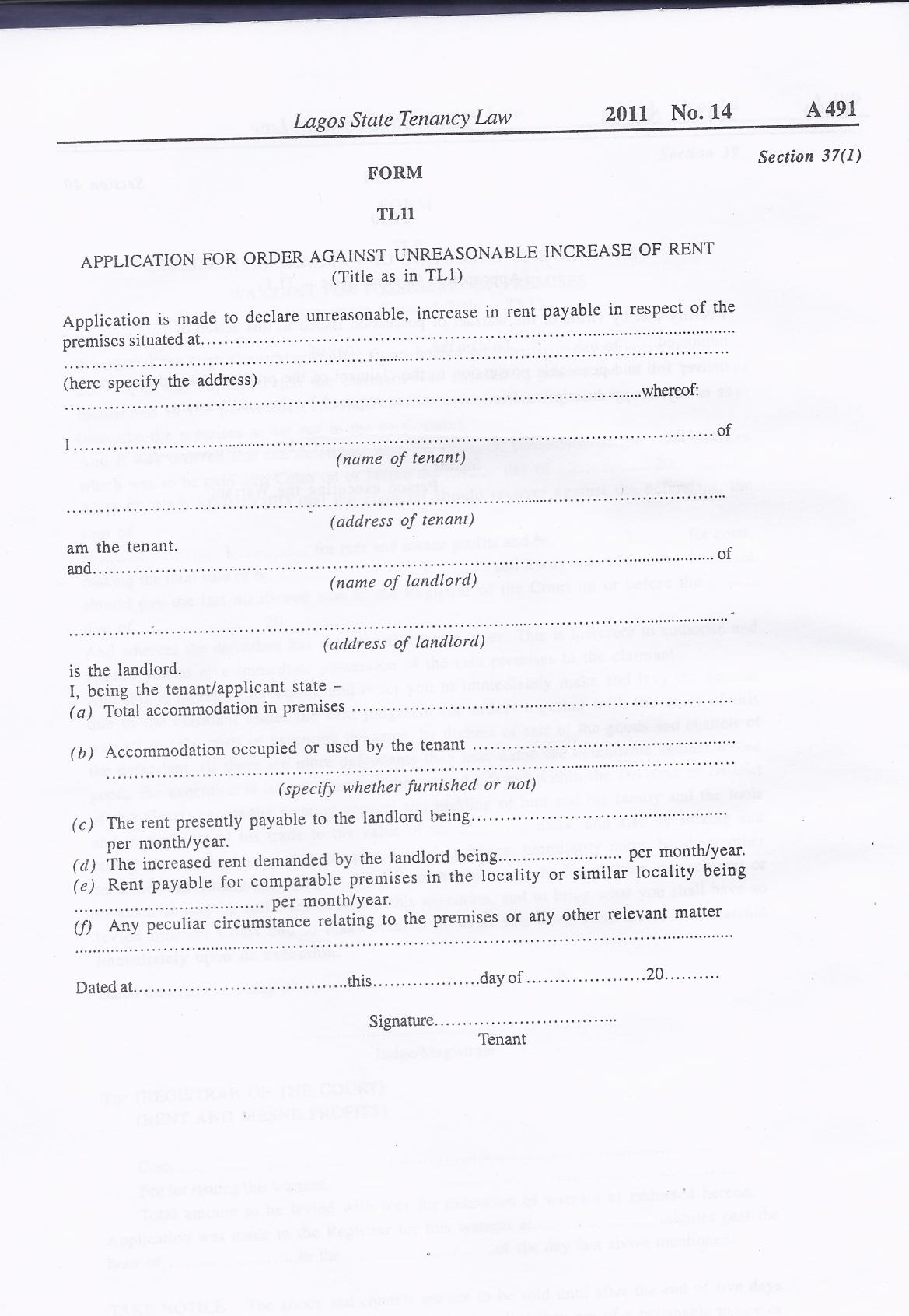
What Can I do About An Unreasonable Increase in Rent?

Someone asked me this question yesterday and, as with most questions on the application of law in Nigeria, the legally accurate answer frequently varies from the practical answer. In this instance, I had no clue what the legal answer was and promised to respond to the asker today (after looking it up in the office).

Under the Lagos State Tenancy Law of 2011, it turns out you can make a complaint to the Rent Tribunal about an unreasonable increase in rent (“…apply to the Court for an Order declaring that the increase in rent payable under a tenancy agreement is unreasonable.”).

Image

What will the court look at in determining whether or not the increase is unreasonable? The general level of rents in the locality or a similar locality for comparative analysis, mostly. The court may also take evidence of witnesses and consider any special circumstances relating to the rented property.

Image

If the court agrees that the increase in rent is unreasonable, it may order the increase in rent to be changed to a specific amount. Finally, to the benefit of the tenant, it is unlawful for the landlord to eject a tenant from the premises while the proceedings to determine the reasonableness of the rent increase are pending.

The practical answer? Litigation should only be resorted to where negotiations have failed.

Mirrors, Signal, Manoeuvre – The Traffic Dilemma

One of the extras I acquired in my time as an expatriate post-grad was a UK driver’s licence. I had to get a learner’s permit and go (back) to driving school. For the first two lessons, I was extremely indignant. I’d been a “licensed” driver for roughly 10 years and considered myself extremely competent. I didn’t understand why the Brits treated passing one’s driving test like we celebrate JAMB or SSCE scores. I quickly realised however that, even with my slightly-above-average knowledge of the Highway Code (my dad insisted at the time), I had picked up bad habits that I needed to un-learn, otherwise I was sure to fail the test (which only has a 45% pass rate anyway – with men testing better than women, in case anyone’s interested). Luckily, I passed on the very first attempt.


Bringing those “good” driving habits back made motoring in Lagos very frustrating initially but Lagos is really one of those if-you-can’t-beat-them-join-them places. People blaring their horns at the slightest excuse (many commercial drivers for absolutely no reason whatsoever), flagrant disregard for road markings (especially zebra crossings), random/indiscriminate stopping on the road, no idea of lane discipline (you’re exiting left but you stay on the extreme right lane and wait until the last possible second to veer dangerously left), etc. I was therefore reasonably happy when it was announced that a “new” traffic law was about to be enacted in Lagos, particularly as it mentioned enforcing the roundabout rule (giving way to traffic on the left).


In spite of its draconian elements (banning any eating or drinking while driving), I have chosen to be optimistic about the new law because it will increase sanity and order on our roads. In Lagos, that can only be a good thing. I realise, of course, that over-zealous LASTMA officials and some policemen will give asinine interpretations to what actions constitute traffic offences but I think, like it happened when seatbelts and those idiotic reflective stickers were required, things will gradually rationalise. So, yes, optimism for now.


On the flipside however, a good law should answer more questions than it poses (CAVEAT: the law itself has not been published and all comments made by the public so far are on the sections that the government chose to highlight) and the public response shows that more needs to be done with having consultations before bills are drafted. If a government white paper (or policy document) had been drawn up and properly circulated prior to the bill itself receiving so much prominence, the thinking behind banning any sort of ingestion while driving would be clear. Now, everyone just thinks it’s silly and as a result the public isn’t fully endorsing the law.


Many have said the punishments for driving in a prohibited direction (“one way”) are too severe, given the potential prison term of 3 years. My first response to this was simply, don’t do it then. But my mind did a Nollywood-style flashback to the first time I drove to Lagos from Ibadan and got “arrested” by the “council task force” for a “one-way” violation. The road had no signage but, as “heegnoranz hees not heckscuze”, I still had to part with a bribe to be able to continue my journey. To convince us that this isn’t another poverty alleviation programme (for LASTMA) LASG/LASAA must therefore ensure that all roads are properly marked (they mostly are on the Island, though). We too as citizens must force the hand of government. Take and circulate pictures of the entry-points to unmarked “one-way” roads. It would also be a great idea for LASG to make it compulsory for every vehicle to have a copy of the Highway Code (which would make an excellent supplement to Complete Sports for danfo drivers’ downtime).


Finally, I’ve been trying to point out for some time that many of the traffic offences this new law covers are not actually new. Sometime in 2009, I saw 2 LASTMA officials shoving a driver out of his vehicle and driving it off. I knew they had the power to impound but, curious to know the extent to which they could exercise this power, I dug out the Lagos State Traffic Management Authority Law of 2004. Unsurprisingly, as it seems to appear for its successor, the law is vague on how LASTMA should “impound” a vehicle. What did surprise me was a variety of offences of which I was unaware, as well as the fact that points can be put on your license (well, theoretically, anyway). I’m reproducing a few of the offences and penalties below. Please remember that this is the old (2004) law.


VIOLATION

PENALTY

POINT

FINE

N

ADDITIONAL

Driving without a Driver’s Licence

2

2,000

Impound Vehicle

Learning to drive on a major highway

3

2,000

Dislodge Driver

Driving with fake number plates

4

4,000

Impound Vehicle

Driving a vehicle with unauthorised or defective reflective number plate

2

2,000

Impound Vehicle


Violation of route by commercial vehicle

2

2,000


Disobeying traffic control personnel or traffic signs

1

2,000

Disobeying traffic lights

4

5,000


Failure to yield to right of way of pedestrians at a zebra crossing

4

5,000


Failure to give way to traffic on the left at a roundabout

2

2,500


Driving under the influence of alcohol and/or drugs

2

2,000

Impound Vehicle

Smoking while driving

1

2,000


Tailgating an emergency vehicle

4

5,000


Failure of slow-moving vehicle to keep to the right lane

2

2,500


Assault on a Traffic Officer

4

5,000

Prosecute in court

Driving in a direction prohibited by the Road Traffic Law [i.e. “one-way”]

4

25,000

Impound

Bullion vehicle driving in a direction prohibited by the Road Traffic Law

4

50,000

Impound

Illegal U-Turns

2

2,000

Driver Training

Making or receiving phone calls when driving

2

2,500


Failure to display reflective warning triangle sign [i.e. “C-Caution”] at point of breakdown

4

10,000


Ballot Boxes & Patents


Sometime in June this year, it was reported that a Federal High Court judge in Abuja had purported to invalidate the entire 2011 general elections as a result of a successful patent infringement suit against the Independent National Electoral Council and a few other parties. The plaintiff contended that its patent to transparent and collapsible ballot boxes was infringed by INEC, as INEC did not obtain its permission to use said ballot boxes in the conduct of the 2011 elections (see a concise background report here).


Surprisingly, 


very little fanfare followed the judgement, due possibly to the incredulousness of it all. First of all, there are all the jurisdictional issues. The Federal High Court, for instance, has no jurisdiction over whether or not a person has been validly elected President or Vice-President (section 239, 1999 Constitution). Also, would the ruling take precedence over the concluded and ongoing election petition matters all over the country?


There is also the issue of the appropriateness of the judgement in the context of what the Patent and Designs Act stipulates as the consequences for infringement. First of all, it is unclear whether the conduct of elections would fall under “commercial purposes” (section 6 (3) (a)) so as to constitute infringement. Secondly, the remedies for infringement under t


he law (section 25 (2)) are injunction (i.e. court bans INEC from using patented invention), damages (i.e. compensation to holder of patent) and accounts (i.e. INEC handing over all profits  it made from the unlawful use or exploitation of the patented item).  Why, therefore, would an order be made invalidating the entire elections as a result of a purported infringement?


The greatest concern, however, should be how a transparent ballot box can be deemed a patentable invention (see here for detailed analysis of patentability in Nigeria). A ballot box is a box with a slit at the top for pushing ballots in. A transparent ballot box is a box that is transparent and on the top of which a slit has been made for inserting ballots. What is the novelty in a transparent ballot box? Where was the inventive process?


Ballot-box-in-dispute-which-is-no-longer-in-use

Section 1 of the Patents and Designs Act is extremely clear and I reproduce it in full below:


1.       (1) Subject to this section, an invention is patentable-


(a) if it is new, results from inventive activity and is capable of industrial application; or


(b) if it constitutes an improvement upon a patented invention and also is new, results from inventive activity and is capable of industrial application.


(2) For the purposes of subsection (1) of this section-


(a) an invention is new if it does not form part of the state of the art,


(b) an invention results from inventive activity if it does not obviously follow from the state of the art, either as to the method, the application, the combination of methods, or the product which it concerns, or as to the industrial result it produces; and


(c) an invention is capable of industrial application if it can be manufactured or used in any kind of industry, including agriculture.


 It will surprise most readers that the extent of the scrutiny of patent claims by the Patents Registry is as to mere formal validity (i.e. they only check that the 6 or 7 documents required to be deposited have been deposited). They do not examine the novelty of the claims in the application and there is no system for detecting whether or not an application potentially infringes an earlier grant of patent. So, yes, I could walk into the Patents and Designs registry tomorrow and be granted patents for the iPhone and the iPad and their constituent parts and processes. In fact, it has been reported here that “the registrar of patent went ahead to issue the same patents to other companies without first invalidating the right of [the Plaintiff in the suit against INEC]”.


The picture isn’t too great on the service supply side either. In “developed” countries, most patent attorneys were engineers, pharmacists, physicists, etc, before studying law. As far as I’m aware, Nigeria does not have any patent attorneys – we are largely agents; filing the claims that foreign patent attorneys have drawn up.


Apparently, INEC has issued a statement declaring that it no longer uses the “infringing” boxes but it would have been very interesting to see where appealing this Federal High Court ruling would have taken the matter.