Of Bullies and The Fickle

In our country, there is a customary acclamation that follows the writings of some people, regardless of the depth (or otherwise) of their summations. Such writers are usually either people who have paid their dues in theie profession (or the public eye) and whose reputation therefore precedes their publications; or they are people who generally produce populist material (populism, of course, isn’t necessarily a bad thing but that’s probably a discussion for another day). I think that in Chief Dele Momodu, we may have a combination of both. The good Chief’s most recent piece on the “bully” that is the Central Bank Governor, in my opinion, fully supports my belief.

The article starts with the propositions that Mallam Sanusi is a poor student of history and that Nigerians are fickle (these may very well be so, but that is not my grouse with his piece). He proceeds to recount Nigeria’s political upheaval from Shehu Shagari to the second incarnation of the Obasanjo presidency, to illustrate how today’s political darling is tomorrow’s scorned lover. Thereafter, the article places Mallam Sanusi firmly in its cross-hairs and fires salvo after salvo at Sanusi’s character, with absolutely no effort made at any analysis of the policies being decried.

According to Chief Momodu, Sanusi is all of the following – lord of a fiefdom, a reckless spender [on outlandish projects], academically brilliant but unbridedly radical, someone who does things in the extreme and lacks the tolerance to persuade others, a loose canon, a sword of Damocles against his foes, vainglorious, rabblerousing, sharp-tongued, attention-seeking, a bully. Of course, in the traditional way that one public figure criticising another usually does, he pays him a (nearly paradoxical) compliment – Sanusi is also princely and charming. Awwww.

We are then treated to an encyclopaedia’s definition of “bullying”, which as most people now know, is a faux pas in academic documents as well as those of the rather serious nature that public commentary is. It is insightful too to read that while Sanusi “[took] on and sacked otherwise brilliant bankers” (emphasis on ‘otherwise’ mine), Chief Momodu also refers to him as “… a Sanitory Inspector in the cesspool of banking mess.” (So, which is it?) Finally, the article ends with Chief Momodu’s opinion on why the N5,000 note palaver has reached its current position, which is the issue that precipitated the article.

I believe that a man who would be president needs to make a more strenuous effort at public/economic commentary. We can surmise from the good Chief’s summation that he disagreed with Sanusi on the N5,000 note. However, because all we see is a list of what he perceives as Sanusi’s character defects, we can only conclude that Momodu disagrees with the N5,000 note because of Sanusi’s character; because Sanusi is an unbridled radical (or attention-seeking, or rabblerousing, or any of the other choice words he used).

There is also the suggestion that that Sanusi did not gauge the mood of Nigeria before embarking on his “N5,000 note misadventure”. For me, this is the most worrying line in the article. Apart from side-stepping the statutory corporate governance structure of the Central Bank (and making this a wholly Sanusi issue), I disagree that a regulator must only use its statutory power in line with the public mood. Think of the stagnation and anti-development this would cause in immigration or taxation or enforcement of health and safety standards, for example. Being a good leader sometimes requires making the unpopular choice.


The truth is that, by law, the CBN has a Board of Directors “responsible for the policy and general administration of the affairs and business of the Bank.” The Board comprises the Governor (who doubles as its chairman), four Deputy Governors, the Permanent Secretary of the Ministry of Finance and five directors. The five directors are to be appointed by the President of Nigeria and each of them is required to be “a person of recognized standing in financial or banking affairs”.

In matters of the country’s currency, the CBN Act states that “Currency notes and coins issued by the Bank shall be in such denominations of the naira or fractions thereof as shall be approved by the President on the recommendation of the Board.” This suggests that before the announcement of the dates for the introduction of the new currency was made, the Board must have recommended it to the President and President Jonathan must have approved it. I am therefore surprised at the direction in which populism has steered discussion on this policy.

Am I suggesting that every government policy should be accepted? Of course not. Do I think the introduction of the N5,000 note would have been good for Nigeria? I am not an expert in economics and my personal feelings are irrelevant, although I cannot help but notice the deafening silence and lack of suggested alternatives to the CBN’s clear and present cash handling and cash management issues and costs.

When people who do not know better ask dodgy questions such as “how do you reconcile the cashless/cashlite CBN policy with the N5,000 note?” I say, leave them, for they do not know any better. Educate them, if you will. However, when a figure of Chief Momodu’s stature, history and leanings doesn’t separate the character of the CBN governor from whether or not we have an efficient vibrant central bank today, then more than the plaudits that followed that piece, eyebrows must be raised and questions asked.

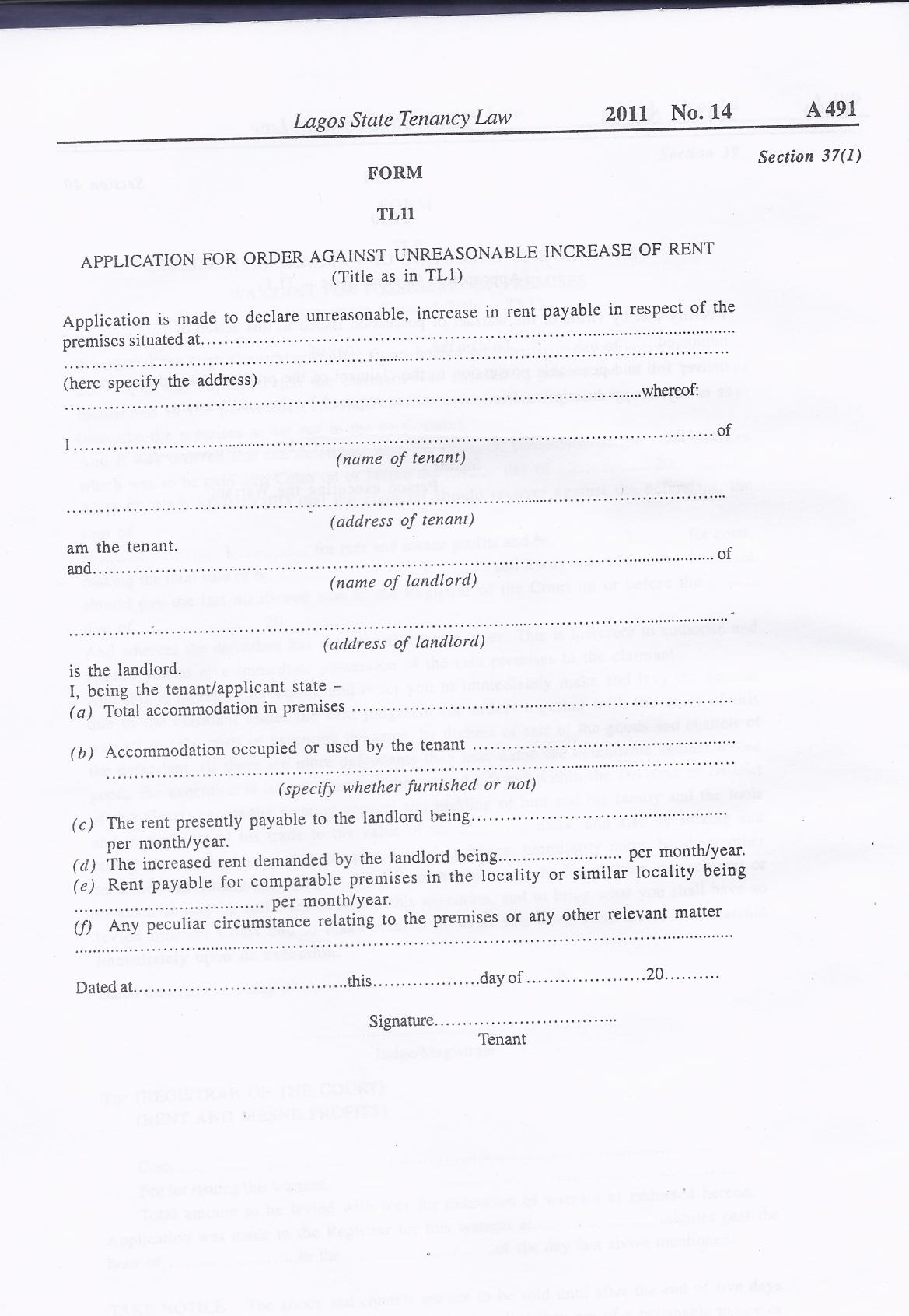
What Can I do About An Unreasonable Increase in Rent?

Someone asked me this question yesterday and, as with most questions on the application of law in Nigeria, the legally accurate answer frequently varies from the practical answer. In this instance, I had no clue what the legal answer was and promised to respond to the asker today (after looking it up in the office).

Under the Lagos State Tenancy Law of 2011, it turns out you can make a complaint to the Rent Tribunal about an unreasonable increase in rent (“…apply to the Court for an Order declaring that the increase in rent payable under a tenancy agreement is unreasonable.”).

Image

What will the court look at in determining whether or not the increase is unreasonable? The general level of rents in the locality or a similar locality for comparative analysis, mostly. The court may also take evidence of witnesses and consider any special circumstances relating to the rented property.

Image

If the court agrees that the increase in rent is unreasonable, it may order the increase in rent to be changed to a specific amount. Finally, to the benefit of the tenant, it is unlawful for the landlord to eject a tenant from the premises while the proceedings to determine the reasonableness of the rent increase are pending.

The practical answer? Litigation should only be resorted to where negotiations have failed.

Mirrors, Signal, Manoeuvre – The Traffic Dilemma

One of the extras I acquired in my time as an expatriate post-grad was a UK driver’s licence. I had to get a learner’s permit and go (back) to driving school. For the first two lessons, I was extremely indignant. I’d been a “licensed” driver for roughly 10 years and considered myself extremely competent. I didn’t understand why the Brits treated passing one’s driving test like we celebrate JAMB or SSCE scores. I quickly realised however that, even with my slightly-above-average knowledge of the Highway Code (my dad insisted at the time), I had picked up bad habits that I needed to un-learn, otherwise I was sure to fail the test (which only has a 45% pass rate anyway – with men testing better than women, in case anyone’s interested). Luckily, I passed on the very first attempt.


Bringing those “good” driving habits back made motoring in Lagos very frustrating initially but Lagos is really one of those if-you-can’t-beat-them-join-them places. People blaring their horns at the slightest excuse (many commercial drivers for absolutely no reason whatsoever), flagrant disregard for road markings (especially zebra crossings), random/indiscriminate stopping on the road, no idea of lane discipline (you’re exiting left but you stay on the extreme right lane and wait until the last possible second to veer dangerously left), etc. I was therefore reasonably happy when it was announced that a “new” traffic law was about to be enacted in Lagos, particularly as it mentioned enforcing the roundabout rule (giving way to traffic on the left).


In spite of its draconian elements (banning any eating or drinking while driving), I have chosen to be optimistic about the new law because it will increase sanity and order on our roads. In Lagos, that can only be a good thing. I realise, of course, that over-zealous LASTMA officials and some policemen will give asinine interpretations to what actions constitute traffic offences but I think, like it happened when seatbelts and those idiotic reflective stickers were required, things will gradually rationalise. So, yes, optimism for now.


On the flipside however, a good law should answer more questions than it poses (CAVEAT: the law itself has not been published and all comments made by the public so far are on the sections that the government chose to highlight) and the public response shows that more needs to be done with having consultations before bills are drafted. If a government white paper (or policy document) had been drawn up and properly circulated prior to the bill itself receiving so much prominence, the thinking behind banning any sort of ingestion while driving would be clear. Now, everyone just thinks it’s silly and as a result the public isn’t fully endorsing the law.


Many have said the punishments for driving in a prohibited direction (“one way”) are too severe, given the potential prison term of 3 years. My first response to this was simply, don’t do it then. But my mind did a Nollywood-style flashback to the first time I drove to Lagos from Ibadan and got “arrested” by the “council task force” for a “one-way” violation. The road had no signage but, as “heegnoranz hees not heckscuze”, I still had to part with a bribe to be able to continue my journey. To convince us that this isn’t another poverty alleviation programme (for LASTMA) LASG/LASAA must therefore ensure that all roads are properly marked (they mostly are on the Island, though). We too as citizens must force the hand of government. Take and circulate pictures of the entry-points to unmarked “one-way” roads. It would also be a great idea for LASG to make it compulsory for every vehicle to have a copy of the Highway Code (which would make an excellent supplement to Complete Sports for danfo drivers’ downtime).


Finally, I’ve been trying to point out for some time that many of the traffic offences this new law covers are not actually new. Sometime in 2009, I saw 2 LASTMA officials shoving a driver out of his vehicle and driving it off. I knew they had the power to impound but, curious to know the extent to which they could exercise this power, I dug out the Lagos State Traffic Management Authority Law of 2004. Unsurprisingly, as it seems to appear for its successor, the law is vague on how LASTMA should “impound” a vehicle. What did surprise me was a variety of offences of which I was unaware, as well as the fact that points can be put on your license (well, theoretically, anyway). I’m reproducing a few of the offences and penalties below. Please remember that this is the old (2004) law.


VIOLATION

PENALTY

POINT

FINE

N

ADDITIONAL

Driving without a Driver’s Licence

2

2,000

Impound Vehicle

Learning to drive on a major highway

3

2,000

Dislodge Driver

Driving with fake number plates

4

4,000

Impound Vehicle

Driving a vehicle with unauthorised or defective reflective number plate

2

2,000

Impound Vehicle


Violation of route by commercial vehicle

2

2,000


Disobeying traffic control personnel or traffic signs

1

2,000

Disobeying traffic lights

4

5,000


Failure to yield to right of way of pedestrians at a zebra crossing

4

5,000


Failure to give way to traffic on the left at a roundabout

2

2,500


Driving under the influence of alcohol and/or drugs

2

2,000

Impound Vehicle

Smoking while driving

1

2,000


Tailgating an emergency vehicle

4

5,000


Failure of slow-moving vehicle to keep to the right lane

2

2,500


Assault on a Traffic Officer

4

5,000

Prosecute in court

Driving in a direction prohibited by the Road Traffic Law [i.e. “one-way”]

4

25,000

Impound

Bullion vehicle driving in a direction prohibited by the Road Traffic Law

4

50,000

Impound

Illegal U-Turns

2

2,000

Driver Training

Making or receiving phone calls when driving

2

2,500


Failure to display reflective warning triangle sign [i.e. “C-Caution”] at point of breakdown

4

10,000