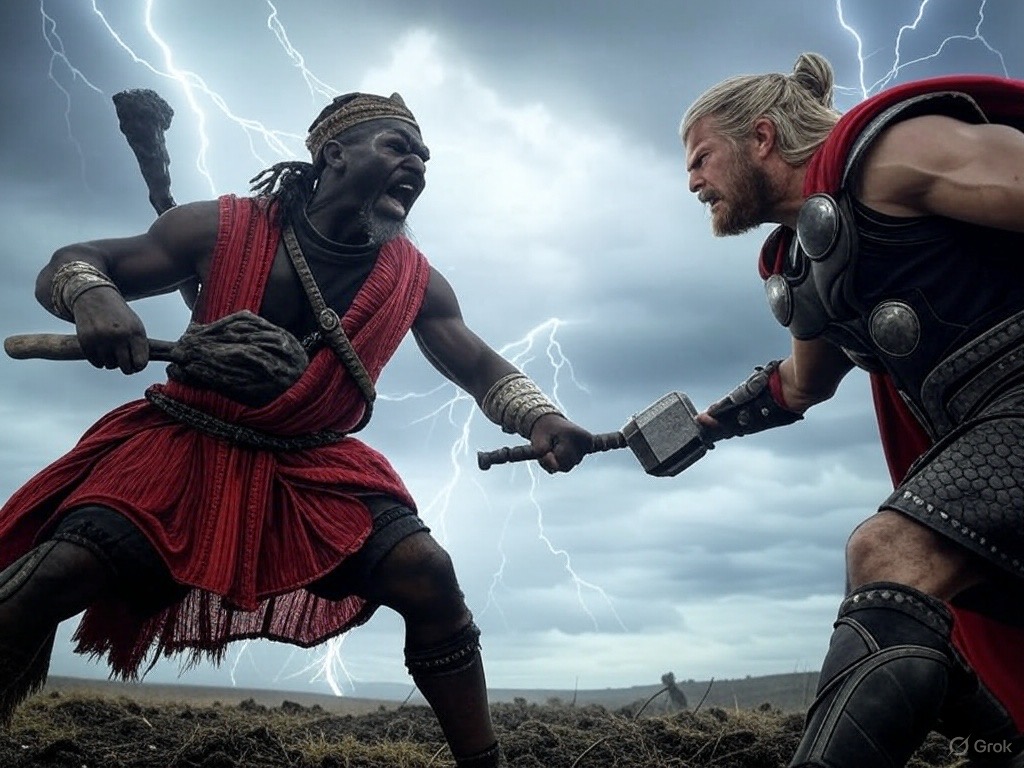
Wahala in Valhalla – Part Six

Disclaimer: This is not intended to be faithful to the myth or canon of any of the deities described in this series. If you are a stickler for the traditional origins and lore, this would be a good point to close the webpage.

With Shango and Thor gone, a semblance of calm returned to the Great Hall. Loki stood beside Odin, as they finally welcomed the einherjar individually to the feast. “I think we are going to see Shango again, and soon. Sooner than you think,” Odin said to Loki.

Meanwhile, Shango could not believe that Thor had found the oshe so easily. “You had something to do with this!” he accused.

“Calm yourself, outsider. A few hours ago I didn’t even know you existed.”

“You will not call me ‘outsider’ in my domain, Asgardian. And you will hand me my axe.”

“If it’s yours, it should come to you when you call it.” Thor taunted.

“So Mjolnir is mine, then?” Shango sneered back.

“Brothers!” Eshu interjected, afraid that they would start to fight again. “All is well that ends well – Shango can complete the coronation now. And Thor can return to Asgard.”

Thor turned to look at Eshu. “Except it hasn’t quite ended has it?”

“Why do you think Shango will return, Father?” Loki asked.

“Because it was you who took who took his axe, wasn’t it?” Odin snapped his fingers and Loki’s body began to change to change shape. ‘Loki’ wasn’t Loki. It was Eshu.

Shango looked at Thor, confused. “How do you mean, Asgardian?” Thor grabbed Eshu firmly by the wrist and Eshu squirmed, trying to wrest himself free. Shango thought to demand that Thor unhand Eshu but something made him pause.

“Here is your axe, Shango,” Thor said. “Go and bless your people’s king. I will return to Asgard with my brother Loki and I will hold your mischief god until your return.”

“Loki? This is Eshu.”

“No, it isn’t. And I’ve known since we left Asgard that he and my brother exchanged places. I don’t know what they have planned but I intend to find out. When you are ready to to return, come back to this place and call out to Heimdall – he will bring you back on the Bilrost. More suitable for godly travel. Heimdall!!”

Loki changed back into his real form, as Heimdall sent down the bridge for Thor. “I like the double axe. I will have one made. Much larger, obviously. It will be a breaker of storms. I will see you soon, Shango.” And with that, Thor and Loki were gone.

The Oluwo knew he was out of time. The Alaafin had to be crowned. He did not know why Shango had withdrawn from them and made a note to seek guidance on what to do to bring back the orisha’s graces. The other priests sighed with relief when they saw him emerge from the shrine but the worry on his face meant it was short-lived.

Suddenly the Oluwo’s demeanour changed completely and his face lit up. The orisha was with them again. The crown was placed on the new Alaafin’s head and in that moment, like nearly all his predecessors on the throne, the royal father felt the faintest of touches on his forehead and power coursing through his body. And then it was gone.

“Kabiyesi!!!” The people proclaimed. “May the crown endure on your head and shoes on your feet! Long live the king!!”

THE END

Wahala in Valhalla – Part Five

Disclaimer: This is not intended to be faithful to the myth or canon of any of the deities described in this series. If you are a stickler for the traditional origins and lore, this would be a good point to close the webpage.

Thor charged at Shango, looking to knock him off balance, but Shango was light of foot and side-stepped Thor. Thor opened his hand, calling for Mjolnir, but Shango would not let go of the hammer. So he was lifted off his feet towards Thor, who drove his fist into Shango’s face with his other hand. Shango fell backwards, slightly dazed, the hammer a few metres out of his reach.

The einherjar cheered loudly. Odin moved as if to intervene. Loki saw and quickly intercepted. “Thor will never forgive you, if you end this now, Father.” He reasoned. Odin heaved a sigh of resignation and remained where he was.

Shango got up to his feet, rubbing his jaw. It was a long time since he had felt pain, perhaps not since he was human. Thor saw that he had rocked Shango.

“The audacity to invade my kingdom, outsider, my domain, and demand my hammer. What do you think the enemies of Asgard will do when they hear of it?”

Thor called Mjolnir and the hammer leapt into his grip. He swung the hammer on its leather handle a few times and flung it at Shango.

Feel me, Shango heard Mjolnir whisper. He was back on his feet, and just before the hammer hit him, in a sweeping motion, he shifted his body weight, grabbed the leather handle and threw the hammer back at Thor. Thor did not see it coming and Mjolnir hit him square in the chest, throwing him back several metres in the courtyard.

“Unless your kingdom is riddled with spies,” panted  Shango, “I would be back with your hammer before any enemies could muster an attack. And why do you still fight wars and come under attack, like mortals? Is your domain not a celestial one, Asgardian?”

Thor was back on his feet. He did not know if it was the blow from the hammer hitting his chest that shook him, or the realisation that it could be wielded against him. He decided not to throw Mjolnir at Shango any longer.

Thor raised his hammer up high and the skies darkened. I know what’s coming, Shango thought. With a loud cry, Thor summoned lightning into his hammer and threw the lightning bolts at Shango. Shango, with an equally ferocious cry, eyes sparking and fire flaming out of his mouth, absorbed the lightning into his body with his left arm and shot it back at Thor with his right. DAPADA!!! Thor parried with his hammer and the bolts deflected onto a section of the palace, blasting it to smithereens. Shango immediately spread both arms out wide and slapped his palms together with a ferocious thunder clap.

The sequence had taken a chunk out of Shango and he flagged, momentarily. Thor sensed this and moved to strike him. Thor punched Shango in the ribs and swung the hammer in an uppercut like motion. Shango ducked with a backflip, kicking Thor in the face, before landing on one knee, clutching his side. The hammer flew off into the parapets of the palace, breaking another wall.

Shango opened his palms out to the heavens and swung down, throwing lightning bolts at Thor. Thor too caught the lightning and sent it back into the skies. It began to rain, lightly at first, and then heavily. “You shall not have my hammer, outsider.”

“I swear you will say my name before we are done here!”

“Never!!”

Eshu looked up, shaking his head. “Do you not have rain in Yoruba?” Loki asked.

“We have rain,” Eshu responded drily. “And it is our people called Yoruba, not our domain.”

“I would like to hear more about your domain, once all the thunder and lightning has abated.” Loki said. Eshu nodded.

The fighting raged between the lightning gods. Both realised quickly that neither would be subdued by lightning or fire and only physical blows seemed to do any damage. Shango feinted a punch with his left fist and followed on with his right. The blow grazed Thor’s temple and he swung the hammer again, aiming for Shango’s chin. He missed and lost his grip on Mjolnir, sending it flying into the sky.

Call me!!

Thor and Shango both stretched out their hands to call the hammer and zipped one way and then the other, not reaching either of them. Thor strained and Shango strained harder, the two summoning the hammer with all their strength. The hammer was now simply rotating in the same place, with equal pull from the clashing deities.

The hammer suddenly stopped spinning as a hand held it in place. It was Odin. “Enough of that now, you two,” he admonished. “Nothing to be gained by this contest or the demise of either of you.”

Both wanted to continue but the authority with which Odin spoke compelled them to pause.

“Thor, my son, my shining star, you will go with Shango to his coronation and let him use Mjolnir for his benediction. Then you will return to us and we shall put this matter behind us. No, no, no, do not protest. I have spoken.”

Shortly afterwards, Thor was on the path back to their realm, with Eshu and Shango. It was a quiet journey with no words said by any of them. They leapt of the cart into the domain of Shango and as their feet touched the ground, Thor at last spoke up.

“My hand tingles. I sense something. It feels like Mjolnir but different. I feel… I feel…” and he stretched out his hand as he would to call his hammer.

There was a whoosh and a thud. And in Thor’s hand was Shango’s oshe.

*** TO BE CONTINUED – ONE MORE PART TO GO ***

Wahala in Valhalla – Part Four

Disclaimer: This is not intended to be faithful to the myth or canon of any of the deities described in this series. If you are a stickler for the traditional origins and lore, this would be a good point to close the webpage.

“His name is Shango and he is trespassing. He does not belong here.” It was Heimdall, son of Odin and nine mothers, watcher of the Bifrost – the rainbow bridge connecting Midgard (the world of men) and Asgard.

“I would pronounce it differently myself,” Shango replied, “but, yes, I am Shango, son of Oranmiyan, the orisha of thunder, lighting and justice. And what are your names?”

Gasps echoed through the Great Hall, everyone shocked at Shango’s unknowingness and his impudence.

“You will bow to the All-Fathers, outsiders!” Thor thundered.

“We will not!” Shango thundered back. Not quickly enough though, for Eshu had already taken a knee in genuflection.

Odin smiled patiently. “Perhaps we should let him answer my questions, and the one Heimdall is undoubtedly bursting to ask. Where have you come from, Shango, what are you doing here and how did you arrive undetected even by Heimdall?”

“I am an orisha from the Yoruba pantheon. Orishas are not ‘gods’ but you may think of me as the god of thunder and lightning. In my pantheon, anyway,” he said returning Thor’s glare.

“Eshu, my companion, is our orisha of chance and mischief and he cloaked us with the likeness of your homeward souls on our journey.”

“He is the Loki to your Thor,” said Odin.

“I don’t know what you mean, apart from him over there being Thor. I am here to borrow his hammer, Mjolnir.”

Again, the gasps rang through the great hall.

“Outsider…”, began Thor.

“ – Shango,” interjected Shango.

“…how dare you utter that name and by what dark design have you come upon its knowledge?” demanded Thor.

“Mjolnir has been speaking to me since we arrived. I think it considers me a friend.”

“Do not vex me, outsider.” Thor warned.

“Again, it is Shango. I do not mean to antagonise you, especially as it is your favour in particular that I have come to seek.”

“Hear him out, brother,” encouraged Loki, who had heard the commotion and come eagerly to see what had so unsettled Thor.

“Thor,” continued Shango, “you see, I began my existence as a human man, of royal birth, and reigned over the largest empire in the land of my people.”

“You want me to lend my hammer to a mortal?” laughed Thor. “You’re not even a god, you’re an ‘orisha’ – is that akin to a demigod?” he teased.

Eshu rubbed his chest, signalling to Shango to reign his temper in. Shango took a deep breath and continued to make his case.

“All the kings who have taken the throne since me have been crowned in my name and at each coronation, I have imbued them with my virtues and power by touching my oshe – my double axe – on their heads in benediction. There is such another coronation today, happening right now, but my oshe is missing. Someone has stolen it. I only need Mjolnir for a few hours and will return it afterwards, on my honour. Eshu can remain here until I return, as a show of good faith.”

“Wait, wait, wait, wait, outsider. Anyone can wield your hammer, or axe, whatever, and you think you’re worthy of Mjolnir?” This time, all the Asgardians laughed with Thor.

Shango felt his palms tingling once more. He heard Eshu whisper again about containing his rage, but a louder voice was drowning out Eshu’s.

Call me. Mjolnir was whispering to him again.

Summon me!  The whisper grew louder.

HOLD OUT YOUR HAND!! Mjolnir commanded with urgency, and Shango complied.

As Shango reached out, to the amazement of Thor, Loki, Heimdall and all the Asgardians, Thor’s hammer detached from its belt and flew right into Shango’s grasp. Red lightning rent the air, searing through the skies and coursing through Mjolnir into Shango.

“OUTSIDER, YOU WILL PUT MY HAMMER DOWN NOW!!!”

“My… name… is… SHANGO!!!” Shango raised Mjolnir in the air and lightning flew once more.

Thor advanced towards Shango and Shango stood ready to defend himself.

*** TO BE CONTINUED ***

Wahala in Valhalla – Part Three

Disclaimer: This is not intended to be faithful to the myth or canon of any of the deities described in this series. If you are a stickler for the traditional origins and lore, this would be a good point to close the webpage.

The edge of the ethereum was every bit as fantastic as Eshu had described to Shango, and the other world was indeed as heavenly as theirs, yet different. It shimmered but with a hue that varied somewhat from that of the orisha plane.

Shango eyed the chasm nervously. It seemed to be changing in size all the time, expanding and contracting in time with the vibrations of the cosmic energy in the atmosphere.

“What now?” he asked Eshu.

“We wait. Or we leap, if you think we can do it in one bound.” Eshu chuckled.

“We don’t have time.”

“Your precious Alaafin might not, but we do. I can’t cross in a single bound but perhaps the mighty Shango might, with me on his back.”

“Be careful with your mockery, Eshu. I may have misplaced my oshe but you still do not want to make me angry.”

“Our earthly followers have a saying.  ‘Anger is the father of hopelessness’ … your Alaafin has 3 hours until he is crowned. We can either go back to look for your oshe, which we may not find in time, or press forward to Thor, whose hammer may not retain its sacredness in our plane, even if he agrees to lend it to you. Either way, your rage, legendary as it is, solves nothing for now.”

Shango’s eyes flashed momentarily but he pulled back. Eshu was right. Besides, he needed Eshu’s stealth to get him close enough to this Thor fellow. He heaved a sigh and stamped with his right foot, rattling his ankle amulets, and settled into waiting.

It was fortunately a very short wait as just then, a path materialised in the void beneath the chasm. On the road, being drawn by two of the largest bulls Shango had ever seen, was the cart filled with the souls of men and women, on the way to the Great Hall. They seemed battle-weary but happy, many brandishing swords. They were also of different physical appearance to the men and woman that worshipped Shango, with straight hair and coloured eyes

Eshu reached out to touch Shango’s hand, and Shango drew it back sharply. Eshu smiled.

“It’s fine if you want to get into a fight on the way to Valhalla in your coronation raiment. Or you could let me sort out our appearance.”

Eshu put his hand on his own head and was instantly transformed. His skin and hair grew paler, his eyes turned blue, and his body markings changed, as did his apparel. “Your turn?”, he said to Shango.

They jumped into the rear of the cart and apart from a few questioning eyes, none of the dead souls questioned their presence. One eventually tried to ask Eshu what battle he lost his life but Eshu only grunted a gruff whisper.

The bulls came up to what looked like palace gates and a guard led the cart the remainder of the way. “Welcome to the courts of Odin, einherjar!” he greeted them. “Come and be received by the All-Father, and his son Thor!!”

“Einherjar?” Shango asked Eshu.

“How is it you understand everything else they’re saying and not einherjar?” Eshu responded, confused.

There was no time for Shango to answer, as the souls processed out of the cart towards the Great Hall. The doors of the Great Hall opened and out of the piercing lights emerged two figures, who could only be gods. Their auras were radiant, they emanated cosmic power and the younger looking one had a hammer hanging from his belt.

Shango’s right hand tingled as he felt the power of the hammer… the power of mjolnir. The hammer had a voice and the voice was inside Shango’s head. A whisper at first, but persistently louder. “My name is mjolnir. Who are you and where have you come from?” over and over again.

Thor and Odin heard it too. “Do you hear that, Father?” Thor queried, beginning to panic.

“You two!!” Odin bellowed, looking directly at Shango and Eshu. “Come forth!”

Shango and Eshu felt themselves being pulled towards Odin, unable to stand to firm. As they got to his feet, Eshu’s masking fell away and both stood there in their usual form.

Eshu cowered slightly but he was emboldened by Shango’s fearless gaze. Shango stood upright and looked straight at Odin.

“You dare look the All-Father in the eye?” Thor sparked.

“Who are you and where have you come from?” Odin asked.

******** TO BE CONTINUED ********

Where Is The Outrage? Take Action Now!

Change AIN’T gon’ come…

Pearl Allison's avatarOlorungemstone

WHERE IS THE OUTRAGE?!

I am quite vexed this morning. I have been following EiE’s petition for Alams especially, to be banned from travelling and I am very disappointed that there have only been less than 1,500 signatures. A thousand five hundred signatures!!!

Really?!

So where are all the people who were making noise and ranting on twitter and facebook about Alams and all those other terrible people being pardoned? Where are you all? Where are all those people who were berating other Nigerians for throwing around #OgaAtTheTop jokes instead of slapping GEJ? C’mon! Surely we can do better than 1,445? Surely! I don send message to facebook friends so tay facebook blocked me from accessing my account. Let us all play a part here. Sign this petition.


1,000 signatures and counting!

Ex Justice Minister, Mike Aondoakaa, sues US for visa revocation. Ex IGP, Hafiz Ringim, seeks asylum…

View original post 262 more words

Navy KabuKabu: The Three Other Fingers

I grew up in what possibly remains, the sanest, most morally upright university campus in Nigeria – the University of Ibadan. I graduated from UI 10 years ago and, especially at that time, the code of ethics enforced by the old guard, many of whom are sadly approaching their terminal 70th year now, was such that vices like handouts-for-profits, sex-for-grades and victimisation were fiercely resisted. This old guard comprised academics who themselves were undergraduates at UI in its glory days and, afterwards, all seemed to find funding for post-graduate studies at the very best universities in the US and Great Britain. Almost a Knights Templar sort of elite, if you like. If your hands were clean, as a student (or a junior member of staff), you could certainly approach equity and equity would rise up in the sturdiest defence of your rights possible.

However, even in the midst of this austere probity and uprightness, there was plenty of the sort of behaviour that many have condemned in the past few days as “abuse of office”. For instance, if someone needed to attend a wedding or funeral outside Ibadan and (as was frequently the case back in the day) they didn’t have a car capable of doing interstate journeys, it was not out of place for one to speak to a friend who was a dean or head of department to borrow an official car and a driver, provided one fuelled the car and ensured the driver received a gratuity for his ‘overtime’. It was not a big deal.

Outside academia, even till the present time, it is not uncommon to find buses with government plate numbers ferrying large numbers of people to and from social events; events that have nothing to do with the official business of the government ministry or department – usually birthdays, weddings and funerals. Many would not give it a second thought or consider it unlawful use of government property.

The same thing probably happens in private establishments. Without thinking about it, many convert business resources to personal use. We’re on social media (or searching for other jobs online) on company time, we download music using the company’s bandwidth, we use the printers and photocopiers to copiously print private material, we use the company phones to make non-business calls, we run our on-the-side business with company resources and so on. Not a big deal either, right?

The fatal helicopter crash of the past weekend has caused many people to question the propriety of using  a naval helicopter to ferry guests between Port Harcourt and Oronto Douglas’s village. The question has been asked with such tenacity that it seems many consider it the issue on which everything around the crash turns. I don’t think the commandeering of the naval helicopter by personnel from the Presidency is any different from our penchant as a people to take advantages of privileges that are available to us. I also don’t think it matters as much as whether or not the aircraft was airworthy or verifying claims that it exploded mid-air rather than crash-landed.

Government must be kept on its toes and remain accountable, yes, but surely this is one of those “living in glass houses” and stone moments. We’re incensed and pointing angrily at the Presidency but, on this occasion, I believe the proverbial three fingers are pointing back at us. As we seek to reform government, we must be mindful that perhaps the greater fight is reforming ourselves, the pool from which government is drawn.

*Braces self for invectives*.

FLYING SOLO

When I quit my old job to go into solo practice, I looked for every single piece of advice I could find, to be sure I wasn’t being foolish. There was a lot of material on the internet about “flying solo” but it was all from the UK and the USA, which is fine until you remember that many of your colleagues studied law thinking life would be like Matlock after graduation. We all realise, a little too late, that Nigerian legal practice is nothing like Matlock.

I was 6 years post-call at the time and while most colleagues, family and friends thought it was “brave” and “a good decision”, the Partners at my old job advised against it and urged me to reconsider my decision for different reasons. One thought it was premature, another suggested I would be unhappy with the type of work I would “regress” into and yet another predicted that a liquidity crunch was coming and even they were apprehensive of what the year ahead had in store for them. At the time, vanity convinced me they just didn’t want me to leave their employment but, three years later, I see that there was some objectivity in their remarks. The almighty liquidity crunch did come (seemingly to stay) and there has been significantly less M&A/Financing/transactional work than I’d anticipated/had grown accustomed to. Was my departure premature? Not really, but I see what my old boss meant.

My Constitutional Law lecturer, the late Professor JD Ojo, would frequently observe in his classes (and also in his capacity as dean of the faculty) that “the practice of law is for the rich”. We were in our late teens and early twenties at the time and reactions to the statement were varied. Prof Ojo studied for his masters and doctorate degrees at the University of London but wasn’t himself a “wealthy” man by most standards, at least not before the Abdul-Salam/Obasanjo transformation of the wages of academics. Thus, people wondered whether or not he saw the irony in his remark. Others were angry at what they perceived a condemnation to a life in penury, given their humble backgrounds. When it was made mandatory for law students to dress in monochrome with proper footwear and we all protested (at different things, including the cost of new wardrobes), Prof Ojo reminded us “without any apologies” that law is for the rich. I have come to agree with him, in a sense. I will return to this point later.

Given that I haven’t been flying solo for that long yet, is there any advice that I can give to someone considering leaving the nest? Let me try. I won’t get into marketing, networking or business development as I’m assuming every new business owner has some strategy or the other for this at the inception of their business.

1.       When is a good time to quit the old job and fly solo?

People leave big law firms for different reasons. Some are terminated and physically pushed out of the nest. Some grow tired of the monotony. Some find themselves on the cusp of an opportunity and need to be masters of their own time to effectively pursue it. Others are fed up with verbal abuse from their bosses.

It’s important to leave for the right reasons and at the right time. I think the best time to leave is when you can afford to leave: young enough to start a business and, in the event that it fails, still be young enough to be employable; if you have a family, they need to be able to remain comfortable while you find your feet; or you leave when you’re already earning so much money on the side that you’re no longer dependent on your salary (kind of like Lagos and Rivers States re federal allocations).

2.       Perseverance

Unless you’re from a wealthy family, with a wealth of ready connections to people in positions that can dispense quality work, it’s likely your stabilisation period will be fairly tough. This is probably where I agree with my old dean. It is much easier to practice law properly with a safety net(work) of family pedigree and all the perquisites that come with it. Otherwise, you need to keep plugging away at it. Persevere Until Success Happens (*kind of stolen jingo*).

3.       “Dirty Work”

There is a great deal of sleight-of-hand and smoke and mirrors out there. You keep seeing this chap who was called two years after you, yet he’s driving Range Rovers and Jaguars. If he’s not a trust-fund baby, chances are he’s a property wheeler-dealer (big ticket transactions rarely trickle down that low). Now, the purist in me hates showing people round empty houses – that’s an estate agent’s work. But there’s an opportunity cost to being a purist. And, positioning yourself to contend with bigger law firms costs money. Sometimes, therefore, you do what you have to do. Again of course, who you are, who you know and who you’ve come to know are also all very important here.

4.       Be an Authority – Be the “Go-To”

If you’re keen to practice law properly, it’s probably best to be well-renowned in your field of practice before you go solo. Yes, your Partners and the name of their firm attract the work while you’re with them but to survive after you leave them, enough of the big-paying clients had better realise that you’re the brains of the operation. That way, they may come looking for you when you leave the nest.

5.       Keep Improving Yourself/the Business

At some point, if the business doesn’t fail, work will come and you need to have the capacity to deliver at “big law” level if you want to retain the client. Capacity, both in the context of intellectual manpower and of technological hardware. You must personally be ready for that time, as must your business.

6.       Consider Staying in the Nest

The image that hardened my resolve to give self-employment a go was a 10yr+ Senior Associate almost on his knees (figuratively, at least) begging for a bonus from the Partners. And then there was the time a senior lawyer was let go without warning. But for every senior associate that carries on in an antithetical way to your ideal, for every seemingly decent lawyer let go, there are another 3 or 4 who rise through the ranks and eventually make Partner. At the end of the day, there’s no rule that says everyone must own their own law firm. Worth considering.

NB. If any other lawyer flying solo wants to add to this list, please send to rfawole@gmail.com. Contributions will receive proper attribution.

MY DISAGREEMENT WITH THE “Mob Justice” BILL

In the wake of the gruesome extrajudicial murder of the four young men who have since come to be known as the “Aluu4”, author Okechukwu Ofili drafted a bill against mob justice and began an online campaign to support the passage of the bill into law. As the act of a concerned citizen not merely contented with wringing his hands and lamenting the abyss that Nigeria is inching towards, it is an act that must be commended. However, if we put the good intentions of Mr Ofili and his supporters aside and examine the substance of the petition and the bill itself, we will find that it actually isn’t as punchy as its enthusiasts believe.

The petition begins with the misconception that mob justice is not a crime in Nigeria. Several tweets were sent out along the lines of “[Counterfeiting stamps] is an offence in Nigeria but mob justice isn’t. Sign the petition and say ‘Never Again’ to mob justice!” I say ‘misconception’ because there is absolutely nothing about “mob justice” (or ochlocracy, as Teju Cole explains) that is legal, even in the international backwater that we frequently agree is Nigeria. After all, mob justice is the colloquial term given to the actions of a group of people taking laws into their own hands and assuming the positions of judge, jury and executioner over persons suspected of committing a crime.

What are the acts that constitute “mob justice”? Typically, the Nigerian “mob” sets on the suspects, strips them naked, beats them senseless and very often murders them by setting them on fire. To say that mob justice is not a crime is to suggest that each of these heinous acts is perfectly legal. Clearly, this position is absolutely untenable.

Before we even venture into the Criminal Code, let us examine the supreme legal document in the land – the 1999 Constitution. Chapter IV of the constitution states the fundamental rights of each and every Nigerian citizen.

Section 33(1) tells us that “[E]very person has a right to life and no one shall be deprived intentionally of his life, save in execution of the sentence of a court in respect of a criminal offence of which he has been found guilty in Nigeria.” Section 34(1)(a) says “Every individual is entitled to respect for the dignity of his person, and accordingly no person shall be subjected to torture or to inhuman and degrading treatment.” Section 36 guarantees the right to “a fair hearing within a reasonable time by a court or other tribunal established by law and constituted in such manner as to secure its independence and impartiality.”

It is clear that nothing that happened in Aluu is “not a crime in Nigeria”, going by the Constitution.

But what about the Criminal Code? Section 315 provides that “[A]ny person who unlawfully kills another is guilty of an offence which is called murder or manslaughter, according to the circumstances of the case.” Sections 351-356 clearly state what constitutes assault. Chapter 54 tells us that it is a criminal offence to conspire with other persons to commit a crime. Grievous harm (i.e. “ bodily hurt which seriously or permanently injures health, or which is likely so to injure health, or which extends to permanent disfigurement or to any permanent or serious injury to any external or internal organ, member, or sense)is also an offence under the criminal code. On the parties to an offence, Section 7 of the Criminal Code is very clear and I reproduce the pertinent part below:

“When an offence is committed, each of the following persons is deemed to have taken part in committing the offence and to be guilty of the offence, and may be charged with actually committing it, that is to say-

(a) every person who actually does the act or makes the omission which constitutes the offence;

(b) every person who does or omits to do any act for the purpose of enabling or aiding another person to commit the offence;

(c) every person who aids another person in committing the offence;

(d) any person who counsels or procures any other person to commit the offence.”

It is therefore also clear that nothing that happened in Aluu is “not a crime in Nigeria”, going by the Criminal Code. Not even standing by or cheering on the murderers.

For me, therefore, the entire campaign was based on an entirely false premise. I was unable to bring myself to retweet or advocate for support for it. The truth is that the so-called “Mob Justice Bill” does not and will not change the law. Mob justice is already illegal. If it wasn’t, there would be no basis for charging the persons who have now been arraigned for the crime that was committed in Aluu.

Is there a bigger implication for social media advocacy? Yes. We cannot sit on our technological high horses and accuse the government of profligacy or inefficiency and engage in conduct that encourages the very same things. If we intend to be taken seriously at the very highest levels, we need to ensure that our actions are not only sentimentally sound but that they are also valid under the rule of law.

There is even a more potentially dangerous side of which we must all be aware. In law school, we are taught that criminal law is the easiest aspect of law for newly qualified lawyers to get into. This is because offences are broken down into separate components and once a lawyer can show that even one component of, say, a five component offence is absent, his client walks. Laws that would create crimes must be mindful of this “flip side”.

Again, we must separate the intentions of the “Mob Justice Bill” advocates from the obviously unintended outcome of their actions. We cannot deny that the Bill was borne out of the desire to make a change and the intention of the promoters of the Bill should be acknowledged.

Finally, does this piece mean that we should all sit down in our comfort zones and do nothing about unlawful killings and extrajudicial justice? By no means. Like most things that are fundamentally wrong with Nigeria, strengthening [democratic and judicial] institutions is the key to progress. The faith of the common man in the justice system must be restored. To achieve this, there must be police and judicial reform. Extensive work has already been done on a framework for the reform of the Nigerian police and can be found here. Turnaround time must be reduced in the judiciary and advocacy that would achieve an end to mob justice would be better channelled, in my opinion, along these lines.

RF (@TexTheLaw)

This Logic Matter

They say the mark of having had a fulfilling time in the university is that not only do you pass through the university but it also passes through you. I’ve never quite been sure if that expression is anything besides a fluffy Nigerianism but, if the university passing through you means that some of the things you learnt remoulded you and will stay with you forever, then logic (aka Philosophy 102 – Arguments and Critical Thinking) really passed through me. Mr. Owolabi, God bless him and his crutch, would frequently say “Let’s do what they’re incapable of doing in Aso Rock; let’s think!”

That elective has probably gotten me into the most trouble with my wife since we met. For some inexplicable reason, I would rather logic prevailed over intuition even though I know full well that life is more than inductive and deductive reasoning. When trying to interpret other people’s actions, more often than not, I use my logic filter. Mrs Tex (whether or not it’s because she’s a woman and therefore more likely to be more intuitive anyway) doesn’t have this ‘handicap’ and over the years my logic has prevailed over her intuition only 1 out of 5 times on the average. Which makes my devotion to it increasingly infuriating for her.

So maybe not everything in life can be subjected to the rigour of testing the validity of the thinking behind them. However, the greatest thinkers of any generation, and their critics and disciples, have no other means of establishing or disputing the authority of their ideas. No meaningful discussion can be had otherwise.  If you want your conclusions to be accepted, you need to give valid, logical, reasons why. It is therefore somewhat sad, for example, to read rejoinders to articles and opinions that, rather than discussing the original issues raised are nothing more than attacks on the person of the original writer. Or, on the comment threads of some online articles, to find an opinion roundly criticised only on the basis that it was expressed by someone from a certain tribe.

Clearly, we are products of our environment and sentiments and bias will have some bearing on the attitudes we adopt and ideas we express. And that’s probably acceptable for private discussions. When ideas are being propounded for public consumption though, I believe logic must relegate sentiments, intuition and bias. I may be wrong but I am convinced that until we elevate the way we discuss issues (and actually discuss issues), especially those of us outside the “cabal” crying for change, we may find progress elusive.

Below are a few examples of prevalent thinking (from the educated segment of our society) – they should give us pause:

  • El-Rufai is only criticising the government because his own party lost the elections [has he raised valid issues?]
  • Kathleen doesn’t support the doctors’ strike because she wanted to marry a doctor but failed to [has she given valid reasons why they shouldn’t have gone on strike?]
  • We know Ijeoma’s antecedents in XYZ corporation, how can she castigate us? [are you guilty of the allegations she has levelled against you, though?]
  • I couldn’t have orchestrated fraud because I actually taught at Harvard [yes, we all know Harvard is next to the Vatican in preparing people for priesthood and sainthood]
  • We’re revoking the contract because it was skewed in favour of the concessionaire [I killed my parents but you should have mercy on me because I’m now an orphan]
  • You’re a foreigner; Nigeria’s issues should only be discussed by Nigerians [Boko Haram issues should only be discussed by terrorism experts too, right?]
  • This kind of backward, myopic (etc) thinking can only be found in the [pick your choice] tribe [and everyone is a genius where you come from? Even that your uncle that the entire family mocks?]
  • Do you know who I am? [If Obama, Putin, Cameron and Merkel jointly put forward a stupid idea, it’s STILL a stupid idea!]

On a lighter note, logic served my friends and I very well at Sade Eleja. There was always someone willing to buy us another round of drinks and catfish peppersoup to prevent us from leaving early. “Mo n gbadun yin gan an…”