(IL)LITERACY IN LEADERSHIP


The Nigerian quest for leadership continues and, unfortunately for progressives, zoning and entitlement to others standing down so that a particular region can enjoy its turn to produce the next president is the current preoccupation of the ruling elite and the chasing pack. The pro-zoning argument is mostly that it corrects marginalisation and encourages “a feeling of belonging”. As there is a gaping lack of evidence that any region has benefitted from being the sitting president’s home-region, one must question what exactly those who protest it are being marginalised from?


The North (I use these geo-political groupings only very nominally) has produced the majority of the country’s heads of government post-Independence. The consensus is however that it is largely the region lacking the most in infrastructure, education and several other key development indices. The South-West had its own turn but no one can point to the exclusive benefit this conferred on the region during those eight years. The incumbent is from the South-South and it would also be hard to point to anything that has accrued to that region specifically. What then can the accusation of marginalisation be in reference to, if the regions do not enjoy special benefits for producing the president? This zoning argument also scales down to politics at the state level, where the governorship “must” be rotated between the different regions that comprise the states. Marginalisation apparently also exists at the state and local government levels too. The majority of the country must therefore be suffering from this malaise of marginalisation at every point in time.


My guess is that it is not the benefits that would accrue to the region that these marginalisation politicians refer to. It is more than likely to be the benefits that accrue to the members of the office-holder’s circle of trust and their hangers-on – the ability to influence appointments (and accumulate political capital), the potential to increase their own personal wealth and [in the tiniest of whispers] the opportunity to assist with how looted funds, if any, will be laundered.. If the President or Governor emerges from your region, you can expect a handsome personal reward depending on how close a friend you are or how prominent a role you played in his election. The cry of marginalisation cannot have very much to do with the progress of the officer-producing region.


It is extremely idealistic but I am hopeful that one day, marginalisation will cease to be the motivation or justification for a candidate’s eligibility, and the most important factor in our choices at the ballot will be the quality of the candidate’s learning and the strength of his character. I have often wondered whether the prosperity of the world’s richest nations has anything to do with how well-educated their leaders are. I finally did some digging this week and the results are in the table that follows. The table tries as much as is possible to either go as far back into time as 1980 or, where the information was not readily available, to list the last four heads of government. The table omits schools outside the US and the UK, as most of us (Nigerian readers) are unlikely to be familiar with their pedigree.


Name of Head of Government

Profession/Education

 
UNITED KINGDOM  

David Cameron

Oxford University, 1st Class in Philosophy Politics & Economics  

Gordon Brown

1st class History

University of Edinburgh, PhD History


Tony Blair

Oxford, 2nd Class BA Arts, later became a barrister  

John Major

O-Levels, Correspondence course in banking  

Margaret Thatcher

Oxford, 2nd Class Honours BSc Chemistry, later became a barrister


UNITED STATES OF AMERICA  

Barack Obama

Columbia University (Political Science, International Relations); Harvard Law School


George W. Bush

Yale University (History), Harvard Business School (MBA)


Bill Clinton

Georgetown University (BSc Foreign Service); Oxford (Philosophy, Politics & Economics); Yale Law School


George H. W. Bush

Yale University, BA Economics


Ronald Reagan

Eureka College, BA Economics

 
GERMANY  

Angela Merkel

PhD, Physical Chemistry


Gerhardt Schroeder

Law


Helmut Kohl

History & Political Science


Helmut Schmidt

Army conscript

 
FRANCE  

Francois Hollande

Political Studies


Nicolas Sarkozy

Law


Jacques Chiraq

Political Studies


Francois Mitterand

Political Science

 
JAPAN  
Shinzo Abe Political Science, Public policy  
Yoshihiko Noda Political Sciences & Economics  
Naoto Kan Patent Attorney  
Yukio Hatoyama PhD, Industrial Engineering  
Junichiro Koizumi Economics  
SWEDEN  
Fredrik Reinfeldt Business & Economics  
Göran Persson Social & Political Sciences (didn’t graduate)  
Ingvar Carlsson


Diploma in Business Economics, BSc in political science  
AUSTRALIA  
Julia Gillard BA, Law
Kevin Rudd BA Arts, Asian Studies
John Howard BA, Law
Paul Keating (No higher education)
Bob Hawke BA Arts, Oxford
SINGAPORE
Tony Tan BSc Physics (1st Class)

MSc, MIT

PhD Applied Mathematics

 
S R Nathan Social Studies  
Ong Teng Cheong Architecture  
Wee Kim Wee Journalist (Political Features)  


There is a preponderance of degrees in political science, law, business, economics and arts (with Singapore throwing its own unique party). Leaders educated in the science of statehood, jurisprudence, commerce and humanities. Of course, this is incomplete, almost half-arsed, data and not much can be gleaned from it. For instance, we do not know from this table if the citizens of these countries prefer leaders with this sort of education or whether it is each country’s political infrastructure that ensures that the cream rises to the top. The table does not examine the presidents’ cabinets and the quality of the team they are surrounded with. We cannot tell if the countries are rich because their leaders are well-educated or whether the leaders are well-educated because the countries are rich.

Regardless, there does appear to be a correlation between the level to which a country’s leaders over time have been educated and how prosperous the country is. This is more so when Sub-Saharan Africa (in which a huge number of the world’s poorest countries are located) is examined in a similar vein and we see several countries that have been pillaged [mostly] by soldiers in the period under review. The soldiers that have usurped civilian rule have also mostly not been of the senior ilk – coups are rarely planned by generals. Many of these countries have also endured long stretches during with the same head of government. Imagine a first-year medical student performing heart surgeries, and answerable to no one for the inevitable cock-ups.

Going forward, while I realise that the “masses” probably do not care much for what university the president went to nor, indeed, if he even went at all, the nature of candidates’ education must be taken into greater consideration. It should come as no surprise, for instance, when people who know nothing of the theories of state get onto our television screens and spout heresies. How can we expect such people to be aware of their own responsibilities in the social contract? When merit is perpetually sacrificed on the altar of marginalisation, how can we expect progress or growth? Perhaps our change advocacy needs to make much more of an issue of this.



Before We Abolish the Senate

In recent discussions on the need to cut down the size of government and its expenses, many have questioned whether it is necessary to have two federal houses of parliament. After all, goes the argument, they are virtually never in disagreement with each other. The ruling party controls both chambers and thus, any notion of one operating as a checks and balances mechanism against the other is mere fiction – one set of lawmakers is clearly redundant.

It is tempting, in the red mist of revolutionary fervour, to align oneself with this position and demand, on the singular basis of unnecessary expenditure, that one of the legislative chambers be abolished.

However, we know from basic economics that apart from cash cost, there is also an opportunity cost to be considered when allocating scarce resources.

To ascertain the opportunity cost of moving to a unicameral legislative system, one must first understand the thinking behind designing legislatures to consist of two chambers. My research suggests that there are at least two cogent reasons for it – philosophy and representation.

On the underlying philosophy, NYU law professor, Jeremy Waldron, in a very informative paperwhich I urge every “change agent” to read, begins his discussion with an interesting anecdote, which I have reproduced in full: ‘Herodotus and Tacitus report that the ancient Goths of Germany, when they had to decide anything important – like going to war, or moving their settlements or entering into a treaty – they would debate it not once but twice. The first time, they would debate the issue drunk, the second time they would debate the issue sober. Drunk – to give a bit of vigour and spirit to their deliberations; sober, to add a dimension of prudence and discretion.’

These ancients believed in the wisdom of two different approaches to considering an issue, almost in the style of two-heads-are-better-than-one, with the expected consensus hopefully being somewhere in the middle of the two ‘ideological’ extremes. The idea was also to guard against the likely tyranny of a legislature with no checks.

There is also a less politically correct thesis, which in spite of its inherent classism still rings true.

The fact is if true democracy is really practised, it would result in the supremacy of the will of the masses/the mob (as the majority) over that of the minority elite. Even for the rigid idealists, it is clear that the affairs and policies of state cannot be left exclusively to the will of the majority.

The history of the US Congress provides an excellent example of how bicameralism serves to ease fears of lopsided representation in the legislature. At the constitutional convention, delegates from smaller states were fearful of having no voice in government and advocated representation on an equal basis regardless of the size of the state. Larger states insisted on representation based on population and the convention seemed headed towards gridlock. The bicameral system solved both problems. Each state got an equal number of senators, with the number of lower house representatives being determined by population.

To recap, therefore, bicameralism guarantees against the subjugation of smaller constituent members (population wise) and should also serve as a wiser, calmer counterfoil to the effervescence of the will of the people.

If, in the quest to reform the legislature, we were to opt for a unicameral assembly, what would we be gaining apart from the expected savings in salaries and emoluments?

Currently, we would not be losing much. The president’s party, the PDP, has the majority of the seats in both houses and is therefore the party from which the speaker and the senate president are drawn. Apart from the dispute, a few years ago, over which house was the ‘lower’ house, the two houses have taken identical positions and reached identical conclusions on the issues and laws they have considered.

The senate can hardly be said to have been a calming, more enlightened voice on the house of representatives. The house of representatives itself can hardly be said to be the voice of the masses, there being very little difference in the ilk of members of both houses and the distance between the electorate and those who have represented them so far in this dispensation.

Taken with the relatively insignificant number of laws that would facilitate development and the huge amounts spent on legislators’ remuneration (which embarrasses them to anger each time they’re reminded),  bicameralism does not appear to have demonstrated any of its touted benefits in Nigeria, since the current democratic dispensation began in 1999.

But democracy and reform should be about building enduring institutions. We should be working towards the answer we want, rather than away from what we find undesirable. The distinction between the two is very fine but it exists nonetheless. If each manoeuvre we make seeks to neutralise what we perceive as bad rather than establish the good we desire, we run the risk of ‘playing’ what Arsene Wenger refers to as ‘anti-football’ and establishing an ‘anti-democracy’ – establishing democratic institutions that are primarily designed to handicap government rather than a system for the ages.

Our discussion must therefore not simply be about the financial cost. There are undoubted benefits to bicameralism.

Rather than jettisoning bicameralism, could we think instead of maybe tweaking the version we currently practice to bring it closer to what would be best for us?

Could the constitution be amended such that the Speaker and the Senate President never come from the same party?

Can there be a default number of people-sponsored bills that must be debated each year in default of which the bills pass as presented?

To truly make the senate a bedrock of wisdom, can we work towards minimum educational/experience requirements for would-be senators?

Are there other measures we can employ to ensure that allowances and sham investigations are not all our legislators are preoccupied with? If the answer to all these questions is a resounding no, then perhaps there truly would be no further point to two legislative houses and our dialogue can then move on to creating the best unicameral legislature possible.


This piece was first published in TheScoop.

200 Broken Covenants

On the final weekend of the year 2012, we awoke to the news that Covenant University had expelled roughly 200 students for the gross malfeasance of missing the final church service of the semester (or “term”, some would say). One by one, people trooped into the village square that is Twitter to air their views. The more popular trend of thought was that if indeed there was a violation of school rules (again with the secondary school terminology), the punishment was egregiously excessive. This was more so because the news report suggested that the students were only expelled because the Chancellor of the school was especially angry at the poor attendance at church and the expulsions were summarily handed out.

At the other end of the opinion spectrum were people who believed, given that the expulsion letters reportedly cited violation of a section of the university’s student handbook, that people generally know what they’re signing up for when they enrol at Covenant University and students who knowingly break rules ought to face the punishment.

In the middle, a position taken by many of my learned friends (a cautious lawyer, what a cliché), were people who decided to reserve categorical comments until they had seen the wording of the rules allegedly broken and the punishment prescribed.

Eventually, some wording emerged but not from Covenant University. Some, of the excessive impunity camp, believed they had found support for their position on the website of the National Universities Commission (NUC). According to the excerpt, “(1) A proposed institution shall have an adequate environmental base and shall be open to all Nigerians irrespective  of ethnic derivation, social status, religious or political affiliation. (2) Accordingly, its laws and status shall not conflict with the conventional responsibilities in academia or interfere with avowed traditional institutional autonomy.” Much was made of the first of these two requirements but, for me, it does not go much further than the issue of a candidate’s admissibility into the institution.

Shortly after that, a screen shot of a very pertinent section of the student handbook, the contents of which students reportedly sign to adhere to, began to circulate, the text of which is reproduced in full below.

  • [Unclear but presumably a list of school assemblies]
  • These assemblies are mandatory for all students.
  • No student is allowed to remain in the rooms whenever there is a university General Assembly
  • Any student caught in the hall of residence during any General Assembly shall be issued a letter of warning and may be expelled if the act becomes habitual.
  • Any student caught in the hall of residence during any General Assembly, particularly Chapel Services, Sunday Services and variety Night shall be suspended for four (4) weeks at the first instance and may suspended for One (1) academic session or expelled from the University if the act becomes habitual by being caught twice for this same offence.

This last text puts paid to any controversy. Every organisation, even a religious one, must be governed by rules. These rules cannot be subject to the effervescence of the governing authority’s temper, no matter how divinely we may choose to believe it is being inspired. That is the recipe for chaos and anarchy. What is more, the typical university, private or not, has a proper governance structure. The Vice-Chancellor is the head of administration, with the professors and other senior academics forming the senate. The senate is usually the supreme disciplinary body on campus. It is extraordinarily strange for a student (let alone 200) to be summarily expelled (ie without a disciplinary hearing) merely because the Chancellor (the ceremonial head of the university) commands it. A university that charges top naira for tuition cannot be run like a fiefdom.

However, the reality is that 200 students have been expelled. Two hundred young adults have had their dreams, ambitions and lives truncated without due process being followed. In fact, expulsion isn’t available to the University, even for “habitual” offenders. It is also unclear if the University bothered to sift habitual offenders from first timers. What can these students do about their situation? The idea of a law suit has been bandied and the students would be well within their rights to pursue legal redress. However, they need to be mindful of the fact that law suits in Nigeria take time to reach a conclusion. If Covenant University chooses to appeal a most likely unfavourable judgment (and this isn’t too far-fetched if the Chancellor is as given to whims as the reported command to expel 200 students suggests), they could very well be in court until 2018. Litigation should be the last resort, when all else has failed.

The first step would be to write to the University’s Council, requesting a reversal of the expulsions, highlighting the fact that the punishment meted out was far in excess of what the University rules stipulate. This is not only inappropriate, it is also unconstitutional (s. 36 (6) (8), 1999 Constitution). A copy of the letter should be sent to the head of the NUC, also requesting its immediate intervention. The parents of these students also need to pool their resources together to wage a public relations campaign to get Covenant University to reverse these expulsions. Publish the expulsion letters side-by-side with the relevant sections of the student handbook. Nigerians are typically fearful of ‘victimisation’ but you/your child currently stands expelled – what’s the worst the could happen?

Everyone else who is concerned must also apply as much pressure as they can. Focused, articulate, logical pressure, showing that while we appreciate the need for discipline and conformity to laid down rules, we are also trying to build a society in which constituted authority respects the confines of its power within the same legal framework.

Good King Flashoslas


Flashoslas


Good (?) King Flashoslas looked out o’er the Lekki people

With the 4-eyed man he thought, let us fleece the people

Widen roads and build a bridge, then exact full measure

For a quarter century, jingling pockets, pleasure.


What if they revolt, F said, could we still withstand them?

Do not fret your little head, we will just disband them.

Bring out tanks and sub-machines, gas to end their gathering

When they beat a full retreat, there’ll be no more blathering.


And, the 4-eyed man went on, see their feeble leaning

Gutless, rudderless and poor, full of empty steaming

They are well-renowned, you see, for a deep resilience

After feeble mutiny, they’ll accept their sentence.


-Timmy Flowers, 1734 -1862

A Judicious Judiciary

Professor Charles Debatista, in his Carriage of Goods and International Trade classes, would always remind us that the wheel on which all trade, domestic and international, turns is the principle of pacta sunt servanda – that promises must be kept. If I do not have the confidence that you will uphold your end of a bargain, or that there is a reasonably quick recourse for me in the event of your default, there is no logical reason why I should enter into a commercial relationship with you.

One of the very first questions intending international investors or their lawyers ask in pre-incorporation due diligence is “Do Nigerian courts uphold agreements freely entered into by Nigerians with non-Nigerian parties?” Typically, the question that would follow is “If yes, how long does it take, on the average, for lawsuits for the enforcement of contracts to be concluded?” It was very easy then, to casually respond that the average lifespan of a suit at the court of first instance is 3-5 years, with appeals to the Court of Appeal and the Supreme Court lasting another 2-3 years each, on the average. The math is hard to ignore, however. You could very easily be in court for 10 years trying to get someone to keep his end of a bargain. And even if you had 10 years to fritter away, there are no guarantees that you would be able to afford to keep paying your lawyer for that long.

The negative consequences of a judiciary with this speed of enforcing contracts are quite a few. I have previously retold here how an employer dared his expatriate employees to go to court to claim the 6 months’ arrears of salary he was owing them. Even though they had fixed contracts for 2 years, on the basis of which these workers relocated to Nigeria, this employer called their bluff. Unable to afford the cost or time of a trial, one by one they slunk back to their respective countries. However, this was even on a relatively small scale. An investor bringing in, say, $300million dollars wants to know how quickly he can cut or recoup his losses in the event that his Nigerian partners default on their obligations.

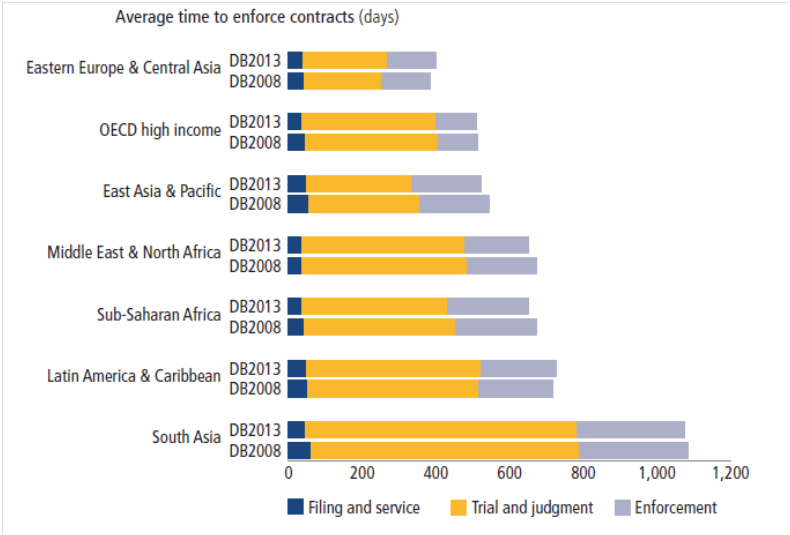
In addition to anecdotal evidence of the consequences of a slightly sluggish judiciary, empirical studies, as reported here (Doing Business – Enforcing Contracts 2013) and here, show that a judiciary that resolves commercial disputes in a timely and cost efficient manner is crucial to a healthy economy. The studies suggest that “countries with slower judicial systems, on the average, have less bank financing for new investment” and that “financial intermediates are likely to reduce the amount of lending if the ability to collect on debts is no longer given or obtaining control over property as collateral to secure loans is denied.” The latter part of the preceding sentence is evident here in Nigeria, where the consensus amongst small business owners is that it is extremely difficult to obtain affordable finance or credit from banks for their businesses.

Table culled from the Doing Business Report

Speeding up the judicial process will also be critical to resolving at least 2 current front-burner issues – corruption in government and the lack of respect for the Rule of Law. The chairman of the Economic and Financial Crimes Commission was recently reported to have expressed frustration with the ability of high profile (political/government) suspects to delay their trials. His lack of faith in the country’s judiciary is shared by the millions who would rather exact summary justice on suspected robbers or rapists than hand them over to the authorities to be investigated and charged.

Nigeria is ranked 87th out of 185 countries in ease of enforcing contracts and 8th most improved since 2005

Speedier prosecutions would lead to many positives. Wrongly accused persons would no longer waste half their lives away in police and prison cells awaiting trial. Public officials would be deterred from stealing public funds because there would be less time to manipulate (or be perceived to be manipulating the system).  The confidence of citizens in the judiciary would also be restored.

So how do we accelerate the dispensation of justice? Let us take a look at Singapore, ranked the easiest country in the world in which to enforce contracts (download data here and sort in descending order) and, coincidentally, also the best country for doing business. In this speech by one of its Justices of the Supreme Court in 2009, the history of the country’s judicial system is recounted, along with the steps taken to reform it and expedite the resolution of civil cases. To summarise, Singapore did the following:

  • Appointed more judges
  • Changed rules of court to empower courts to be more proactive in the management of cases
  • Denied adjournments
  • Gave hearing dates to moribund cases
  • Expanded jurisdiction of subordinate courts (e.g., in the Nigerian context, magistrate and customary courts) in terms of subject matter and size of monetary claims
  • Set and maintained target timelines and benchmarks, for example –
    • Seek to dispose of all cases within 18 months of filing
    • Seek to dispose of more cases than are filed every year, disposing of a number equivalent to 104% of cases filed in 2007)

In Nigeria, Lagos State is easily at the forefront of judicial reform, especially with the appointment of judges and the expansion of the jurisdiction of subordinate courts. Lagos State judges are also mandated by current civil procedure rules to encourage parties to a dispute to settle prior to a full hearing. However, courts in Lagos are still very congested, indicating that there still might not be enough judges. We are provided with an idea of what would be an acceptable ratio of judges to the population in this article on litigation and delays in the Indian judiciary. The article reports that as far back as 1987, the country’s Law Commission had recommended a ratio of 107 judges per million citizens. It is instructive that while India was planning (in 1987) to achieve this target by 2000, the USA had already achieved it in 1981. Another piece, also from India, compares India’s judges per 100,000 to the ratio in “well-administered” countries. The information is reproduced in the table below.

Country No. of Judges/100,000
USA 11
Sweden 13
China 17
Belgium 23
Germany 25
Slovenia 39
India 1.2

What, then, is the current ratio of judges to Nigerian citizens? I spent over an hour trawling through various judiciary websites and even the site of the National Statistics Bureau, with no luck finding out the number of judges (including customary court judges and magistrates) that we currently have in Nigeria. But, making assumptions, on the premises explained below, I reckon we have about 4,000 -5,000 “judges” at the very maximum.

The Supreme Court currently has fewer than 15 justices out of a constitutional maximum of 21 but let us assume a full court. There are currently roughly 70 justices of the court of the court of appeal but let us assume a bloated estimate of 100 judges for both courts. There are also roughly 70 judges of the Federal High Court. Each state has a State High Court. If we use Lagos as a benchmark, with roughly 50 judges per State (an unreasonably high estimate given that there will be several States nowhere near as busy as Lagos, but you’ll soon see where I’m going with this), that is 1850 state High Court judges for all the states and Abuja. This gives a total figure of 2,020 judges. If we then doubled the figure to accommodate judges of the National Industrial Court, judges of the customary court and the customary court of appeal, as well as magistrates, we would have an estimate of roughly 4,000. Thus, even if we assumed a figure of 5,000 judges for a population of 160 million people, the ratio is 31 judges per million individuals (or 3.1 per 100,000), approximately a third of the Indian and American ‘optimum’. The argument for more judges however, needs to be counter-balanced with the need to ensure that the integrity (not in the context of ‘honesty’ – see speech here where the former Chief Judge of Nigeria remarks that expanding the size of the Court of Appeal has led to conflicting judgements) of the system isn’t compromised or lost.

I realise that the references from which my conclusions concerning the judiciary have been drawn were primarily focused on civil proceedings but I see no reason why the same measures cannot be applied to the congestion in the criminal justice system as well. I realise too, however, that the criminal justice system also includes the police. On police reforms, I will again refer readers to the most comprehensive discussion of which I’m aware on the subject, here.

The government has taken many measures to convince foreign investors that Nigeria is a good destination for their money. The Minister of Trade has introduced accelerated the process for obtaining business visas, while the Minister of Aviation also recently announced an investment road-show. The government can give as many assurances as it wishes but it is clear that reducing the speed at which the wheels of the judiciary roll will be one of the most significant steps that will be taken.

Beware the Roads of Lagos

Heegnoranz” can certainly not be “hegscuze” for anyone that falls prey (metaphor intended) to the new traffic law of Lagos State. It has been so well-publicised that one hopes this manner of publicity will follow documents of accountability of the government. The law is available for download here, in case anyone’s still looking for a copy.


I have suggested elsewhere that draconian laws may be the drastic measure needed to get us back in line but, given LASTMA’s penchant for sacrificing the spirit of the law on the altar of its letter and the 1000% increase in applicable fines (in many instances), I may very well rue my words.


So what does the law do? No, it doesn’t ban eating or drinking while driving, at least not specifically (closest I came across was “counting money or otherwise engaged in other activities when driving”). It does however, like its sister Act (*chuckles*) the LASTMA Law of 2004, prohibit smoking while driving. I have set out a table below, comparing some of the old offences and penalties with the newer version. You should probably skip down there if you want to avoid the boring legalese that follows.


The consensus on the law is that the punishments appear to go too far. Apart from this, I think it short on the definitions of some offences. For instance, a driver is liable upon conviction for dangerous driving, to a fine of N100,000 and/or two years’ imprisonment. An offence with such a hefty penalty should not be left solely to the discretion of the LASTMA of today. (See the UK Road Traffic Act and its definition of dangerous driving).


Section 20, on “careless and inconsiderate driving” also throws another curve ball. Subsection (2) appears to give the court the power to direct the accused driver to be charged with a different charge if the court is of the opinion that the original charge has not been proved. This would appear to go contrary to the long-establisheddouble jeopardy rule in criminal law. Apart from being a principle of common law, “double jeopardy” is also prohibited by section 36(9) of the constitution, which reads-

“No person who shows that he has been tried by any court of competent jurisdiction or tribunal for a criminal offence and either convicted or acquitted shall again be tried for that offence or for a criminal offence having the same ingredients as that offence save upon the order of a superior court.”


Driving under the influence of drugs or alcohol is rightly prohibited but, while the law gives LASTMA the power to test blood and urine, no maximum limit is stipulated. You may be charged with this offence if it seems to the LASTMA official that the extent of your inebriation is such that you are “incapable of having proper control of the vehicle.” This sounds reasonable enough but in actual fact, it leaves all the power in the traffic authority’s hands.


There is a fine for abandonment of vehicles. There is a related fine for failing to notify the police or LASTMA that a vehicle has been abandoned near your premises. The law doesn’t tell us what constitutes abandonment, however. If my car breaks down and I have to leave it by the roadside until my mechanic is available, after how long can it be deemed “abandoned”? 12 hours? 24 hours? 48 hours? Whatever LASTMA feels constitutes abandonment?


The motorcycle-related provisions of the law also appear to apply to ALL motorcycles. No distinction is made between private and commercial motorcycles. Thus, technically, LASTMA could arrest a sports bike (“power bike”) rider for being on a route on which motorcyclists have been banned (see page 29 of the law). It must be pointed out that the new restrictions on motorcycle traffic (permits, maximum number of passengers, etc) seem quite sound, however.


It is also an offence for your vehicle to break down on the road and cause an obstruction to traffic. No, that’s not a typo. And you’d be fined N50,000 and still have to pay the cost of towing, Would it not be more reasonable for the State to provide free recovery services to a non-obstructive point, like LCC does on the Lekki-Epe expressway (I don’t believe I just paid LCC a compliment!)?


The question remains though, as to why the fines have been increased so dramatically. Many of these offences already existed, suggesting that a lack of enforcement (and not the mildness of penalties) is the reason why traffic remains chaotic in Lagos. Are the enormous fines a stealth tax or fund-raising initiative?  It would have also helped the considerably large smoker population if the policy behind banning smoking was properly articulated (even though this offence was listed in the 2004 law). Lagos would seem to be the first city in the world to impose such a ban. Perhaps the purpose of the law is even to reduce traffic by making Lagosians too frightened to drive.


In any event, safer driving will ultimately be a good thing and one earnestly hopes that LASTMA and the VIO will adopt a common-sense, non-predatory approach to the enforcement of the new regulations.

Be safe, everyone!


TABLE OF [SELECTED] TRAFFIC VIOLATIONS & PENALTIES

2004 provisions are in black; 2012 are in red


VIOLATION

PENALTY
POINT FINE

N

ADDITIONAL
Driving without a valid Driver’s Licence 2/2 2,000/[no fine stated] Impound Vehicle/payment for removal and storage and evidence of payment for the licence.
Learning to drive on a major highway 3/2 2,000/1st Offender N20,000; subsequent offender N30,000 Dislodge Driver/ payment for removal and storage and evidence of payment for the licence.
Driving with fake number plates 4/4 4,000/1st Offender N20,000; subsequent offender N30,000 Impound Vehicle/imprisonment of 3 years or both fine and imprisonment
Driving a vehicle with unauthorised or defective reflective number plate 2/2 2,000/1st Offender N20,000; subsequent offender N30,000 Impound Vehicle/imprisonment of 3 years or both fine and imprisonment
Driving without a valid MOT Test Certificate 2   Impound Vehicle/payment for removal and storage and evidence of payment for the certificate.
Driving without a valid roadworthiness certificate 2   Impound Vehicle/payment for removal and storage and evidence of payment for the certificate.
       
Violation of route by commercial vehicle 2/2 2,000/ 1st Offender N20,000; subsequent offender N30,000
       
Disobeying traffic control personnel or traffic signs 1/2 2,000/1st Offender N20,000; subsequent offender N30,000
Disobeying traffic lights 4 5,000  
Failure to yield to right of way of pedestrians at a zebra crossing 4/3 5,000/ 1st Offender N20,000; subsequent offender N30,000  
Failure to give way to traffic on the left at a roundabout 2/2 2,500/ 1st Offender N20,000; subsequent offender N30,000  
       
Driving under the influence of alcohol and/or drugs 2 2,000/N100,000 or 2 years imprisonment or both Impound Vehicle
Smoking while driving 1/2 2,000/ 1st Offender N20,000; subsequent offender N30,000  
       
Tailgating an emergency vehicle 4/3 5,000/1st Offender N20,000; subsequent offender N30,000  
Failure of slow-moving vehicle to keep to the right lane 2/2 2,500/1st Offender N20,000; subsequent offender N30,000  
       
Assault on a Traffic Officer(physical) 4 5,000/[no fine stated] Prosecute in court/Imprisonment for a term of three (3) years or both fine and imprisonment
Driving in a direction prohibited by the Road Traffic Law [i.e. “one-way”]/Neglect of traffic directions 4 25,000/[forfeiture of vehicle to the state] Impound/ 1st Offender – one (1) year imprisonment and forfeiture of the vehicle to the State; 2nd and subsequent offender (3) years imprisonment and forfeiture of the vehicle to the state; offenders to have data and biometrics captured.
Bullion vehicle driving in a direction prohibited by the Road Traffic Law 4/5 50,000/ [Forfeiture of vehicle] Impound/Imprisonment for a term of three (3) years, or both fine and imprisonment
Illegal U-Turns 2/3 2,000/ 1st Offender N20,000; subsequent offender N30,000 Driver Training
Making or receiving phone calls when driving 2/2 2,500/1st Offender N20,000; subsequent offender N30,000  
Counting money, or [being] otherwise engaged in other activities when driving 2 1st Offender N20,000; subsequent offender N30,000  
Failure to display reflective warning triangle sign [i.e. “C-Caution”] at point of breakdown 4 10,000  
Causing obstruction on highway if broken down 2 N50,000.00; cost of towing

Ballot Boxes & Patents


Sometime in June this year, it was reported that a Federal High Court judge in Abuja had purported to invalidate the entire 2011 general elections as a result of a successful patent infringement suit against the Independent National Electoral Council and a few other parties. The plaintiff contended that its patent to transparent and collapsible ballot boxes was infringed by INEC, as INEC did not obtain its permission to use said ballot boxes in the conduct of the 2011 elections (see a concise background report here).


Surprisingly, 


very little fanfare followed the judgement, due possibly to the incredulousness of it all. First of all, there are all the jurisdictional issues. The Federal High Court, for instance, has no jurisdiction over whether or not a person has been validly elected President or Vice-President (section 239, 1999 Constitution). Also, would the ruling take precedence over the concluded and ongoing election petition matters all over the country?


There is also the issue of the appropriateness of the judgement in the context of what the Patent and Designs Act stipulates as the consequences for infringement. First of all, it is unclear whether the conduct of elections would fall under “commercial purposes” (section 6 (3) (a)) so as to constitute infringement. Secondly, the remedies for infringement under t


he law (section 25 (2)) are injunction (i.e. court bans INEC from using patented invention), damages (i.e. compensation to holder of patent) and accounts (i.e. INEC handing over all profits  it made from the unlawful use or exploitation of the patented item).  Why, therefore, would an order be made invalidating the entire elections as a result of a purported infringement?


The greatest concern, however, should be how a transparent ballot box can be deemed a patentable invention (see here for detailed analysis of patentability in Nigeria). A ballot box is a box with a slit at the top for pushing ballots in. A transparent ballot box is a box that is transparent and on the top of which a slit has been made for inserting ballots. What is the novelty in a transparent ballot box? Where was the inventive process?


Ballot-box-in-dispute-which-is-no-longer-in-use

Section 1 of the Patents and Designs Act is extremely clear and I reproduce it in full below:


1.       (1) Subject to this section, an invention is patentable-


(a) if it is new, results from inventive activity and is capable of industrial application; or


(b) if it constitutes an improvement upon a patented invention and also is new, results from inventive activity and is capable of industrial application.


(2) For the purposes of subsection (1) of this section-


(a) an invention is new if it does not form part of the state of the art,


(b) an invention results from inventive activity if it does not obviously follow from the state of the art, either as to the method, the application, the combination of methods, or the product which it concerns, or as to the industrial result it produces; and


(c) an invention is capable of industrial application if it can be manufactured or used in any kind of industry, including agriculture.


 It will surprise most readers that the extent of the scrutiny of patent claims by the Patents Registry is as to mere formal validity (i.e. they only check that the 6 or 7 documents required to be deposited have been deposited). They do not examine the novelty of the claims in the application and there is no system for detecting whether or not an application potentially infringes an earlier grant of patent. So, yes, I could walk into the Patents and Designs registry tomorrow and be granted patents for the iPhone and the iPad and their constituent parts and processes. In fact, it has been reported here that “the registrar of patent went ahead to issue the same patents to other companies without first invalidating the right of [the Plaintiff in the suit against INEC]”.


The picture isn’t too great on the service supply side either. In “developed” countries, most patent attorneys were engineers, pharmacists, physicists, etc, before studying law. As far as I’m aware, Nigeria does not have any patent attorneys – we are largely agents; filing the claims that foreign patent attorneys have drawn up.


Apparently, INEC has issued a statement declaring that it no longer uses the “infringing” boxes but it would have been very interesting to see where appealing this Federal High Court ruling would have taken the matter.


Fallacies

This post should probably have come before the immediate past one but I was so convinced that many would find the topic of logic and valid arguments boring. It has come as quite a surprise that the reverse is the case and I’ve been asked by quite a few people to do a full post on fallacies. Apologies, however, if this turns out to be a snooze-inducer. You can blame Mr. Taylor for that (spot the fallacy, if you can).

 To understand fallacies better, there are some basic concepts and definitions that need to be stated first.

 A fallacy, in the context of logic, is simply an error in reasoning or an incorrect argument. Growing up, I thought ‘argument’ was a synonym for disagreement but this is not the case. My philosophy teachers were quick to point out that Fela was a real African philosopher and, true enough, in his music one will often hear “na my argument be dis” or other references to him making an argument. What, then, is an argument? An argument is a proposition comprising a conclusion in support of which premises are put forward. A couple of examples:


Kemi is a girl’s name.                                                  Premise 1.

My intern’s name is Kemi.                                           Premise 2.

Therefore my intern is a girl.                                       Conclusion


My Uncle is a crook.                                                     Conclusion

My Uncle is a politician.                                                 Premise 1

All politicians are crooks.                                               Premise 2


Another point to note is that while a conclusion may actually be the truth, this is not relevant to the fact of the argument being a fallacy. So while it may be true that Girl X is a snob, to demand that I accept this conclusion on the sole premise that she only carries Hermes bags is a fallacy. That would make everyone who uses only designer apparel a snob and that certainly cannot be the case.

The final point of note is that fallacies do have some form of psychological appeal, otherwise they wouldn’t fool anyone. As my trusty old Introduction to Logic by Irving M. Copi says “…the irrelevance (of the conclusion to the premises of the argument) here is logical rather than psychological, of course, for unless there were some psychological connection, there would be no persuasiveness or seeming correctness.” I will be quoting generously from the book, so please do not assume any original thought here. There’s actually a lot of information on fallacies on the internet and the examination done here is very superficial.

The trick in identifying fallacies is to be able to break down what is being said into premises and conclusions and then to analyse if the conclusions follow logically from the premises.

Bearing all this in mind, let us now take a look at commonly committed fallacies.


Argumentum ad Baculum (appeal to force) – this is committed when the maker of a statement appeals to force or the threat of force to cause acceptance of a conclusion. Many good examples are found in the area of politics.

         “Jonathan should not become president otherwise we will make this country ungovernable.”

         “You should implement 100% CONMESS in this State otherwise we will go on strike.”


While it may be desirable that the conclusions we are urged to accept in these statements are indeed accepted, the conclusions do not logically follow from the premise of the threat of force or “strong-arm” tactics.


Argumentum ad Hominem – this occurs when the make of a statement, rather than the validity of the statement itself, is attacked. There are two varieties of this type of fallacy – the abusive ad hominem and the circumstantial ad hominem.


Abusive:

                “Kathleen wanted to marry a doctor but didn’t succeed. Thus, she has a myopic view of the doctor’s strike.” (This is also ad populum – see below).

                “Patience is known to commit frequently grammatical errors, so her opinions on the war in Syria can’t be very useful.”


Circumstantial:

This is different in that it occurs when Person A, rather than proving that his contention is valid, seeks to establish that Person B should accept it because of Person B’s special circumstance.


“You’re black like me. How can’t you see that John was being racist there?”

“I would have thought, being a Yoruba man yourself, you would immediately agree that Usman was rude.”

“Tunde Bakare is a clergyman. He should stay in the church and leave politics alone.”

“You are not a Nigerian. Please leave the fuel crisis for Nigerians alone to discuss.”

“She is not a doctor so she is ill-equipped to comment on the doctors’ industrial action.”

“Rotimi is a lawyer, so no surprise he agrees with what the SAN said.


Argumentum ad Ignorantiam (argument from ignorance) – this occurs when it is argued that a proposition is true simple because it hasn’t been proved false or is false simply because it hasn’t been proven to be true.


“Ghosts don’t exist; you can’t show me otherwise.”

“There is neither a Heaven nor a Hell; prove they exist and I will change my ways.”

“No breath of scandal has ever touched the Senator. Therefore he must be incorruptibly honest.”


In some circumstances, however, such contentions may not be fallacious. If Abubakar is suspected of fraud, for instance, and the EFCC even after extensive investigations cannot prove a single act of fraud, the contention by Abubakar that “I am not fraudulent, the EFCC couldn’t prove any of the allegations” would not necessarily be fallacious.


Argumentum ad Misericordiam (appeal to pity) – this one is self-explanatory. It occurs when the contention is effectively “you should disregard all the rules and laid down procedure because of my especially pitiful circumstances.” If you watch American law dramas you probably know how the appeal to pity works. The defence attorney catalogues the bad breaks and incidences of hard luck that brought his client into pulling the trigger or selling drugs.


“My client is essentially an upstanding, hardworking citizen who through the bad fortune of a series of unfortunate circumstances is standing before you today. If you return a “Guilty” verdict, you will be condemning him to a life he clearly doesn’t deserve; you’ll abandon him to the hardened criminals in our jails; and statistics show that x% of offenders who come out of that facility are forced to return to a life of crime less than 6 months after they get out. Is that what our society is about?” Surprise, surprise, the jury comes back with ‘not guilty’.


Or, the government rescinding a contract it negotiated and signed with the concessionaire because “the agreement was skewed in favour of the concessionaire.”


The most ridiculous example of the appeal to pity is “it is true I killed my parents. But I should’t be sent to jail because I’m now an orphan.”


Argumentum ad Populum – this fallacy is committed when an “appeal to the gallery” (attempting to win popular assent to a conclusion by rousing or referring to the feelings of “the multitude”) is made.  It is a very broad category of fallacies and the same ad populum fallacy can often  also be characterised as one of the previously described fallacies.


“Always buy made-in-Nigeria goods. To do otherwise is not to love your country.”

“I know America is the best country in the world because everybody thinks so.”

“Don’t waste your vote on the Conscience Party; everyone is going to vote PDP or CPC anyway.”


Argumentum ad Verecundiam (appeal to authority) – appealing to the the feeling of respect people have for the famous, to win assent to a conclusion (unless of course, the celebrity is an authority in the subject matter of the argument). A good example would be using the opinions of Einstein, a renowned physicist to support one’s beliefs on religion.


“GEJ is clearly a failure. Even [celebrity x] thinks so.”

“Kia makes great 4x4s. Andre Agassi endorsed them.”


Hasty Generalisation – considering exceptional cases and generalising a rule that only fits those exceptions.


“Bode George and James Ibori, both of the PDP, have been convicted of corrupt practices. Therefore the PDP is a corrupt party.”

“Michael Jackson died of a propofol overdose – the drug is clearly unsafe and should be banned.”

                “All Nigerians are internet scammers.”


Petitio Prinicipii (begging the question) – circular reasoning; where the proposition and contention (or parts thereof) are basically the same.


                “Freedom of speech is a good thing because censorship is evil.”

                “I know the Bible is the word of God because it says so inside.”

“The new student says I am his favourite professor. And he must be telling the truth because no student would lie to his favourite professor.”


Ignoratio Elenchi (irrelevant conclusion) – this fallacy is committed when an argument purporting to establish a particular conclusion is directed to proving a different conclusion.


“El-Rufai’s article is the work of a politically frustrated individual. He only accuses us because his party lost the presidential election.”

“Councillors, with their basic educational qualifications earn hundreds of thousands. Therefore it is right for doctors to go on strike to press for higher pay.”


Here’s to valid arguments.


WHAT IS THIS RULE OF LAW?

Jurisprudence, in spite of the trepidation in which law students typically hold it, like my undergrad philosophy electives, was a truly fascinating course for me. I marvelled at how regular human beings like us devoted their time to critical thinking to develop ideas that would develop their countries and, unknown to them at the time, shape global appreciation of ideas of law and the state. The notion of the rule of law came about as a result of the exertions of these early thinkers.


When the late Umar Musa Yar’Adua assumed office in 2007, he committed his administration to observing and enshrining the rule of law. The phrase became a mantra during his tenure and especially gained popularity when, unlike his predecessors in office, he immediately ordered security agencies to enforce decisions of election tribunals that delivered adverse rulings against his party. While this was widely celebrated, it led to ‘the rule of law’ becoming synonymous with the government ‘permitting’ adverse tribunal rulings to stand.


The rule of law has since become a one-eyed, one-armed and one-legged invalid. Business has carried on as usual, the occasional motorist reportedly continued to be shot by the police for refusing to part with ‘special tolls’ at check-points until they were recently dismantled, high-profile criminal trials go a less-than-usual way, many agencies exceed the scope of their jurisdiction but as long as election tribunal judgements are respected, rule of law watchers continue to give the country a pass mark.


So, what did the original framers of the expression mean? More than a meaning, the rule of law is a concept of many parts – no one is above the law; no one can be punished by the state except for a breach of the law and in accordance with the law; agreements must be kept; no branch of government is above the law; no public official may act unilaterally or arbitrarily outside the law. It means the law, with all its constituent procedures, is (or at the very least, should be) supreme.


The law is clearly yet to be supreme in Nigeria. It should be impossible for parties, including the government, to unilaterally cancel contracts but this is still complained about fairly regularly. Supremacy of the law should mean that accused persons do not spend three years in detention awaiting trial. It should mean, as well, that powerful politicians and government appointees, no matter how highly placed, obey all administrative and judicial orders; seeking orders from the courts to restrain law enforcement agencies from carrying out their statutory and constitutional functions should be thoroughly decried. It should also mean that the law is predictable and any changes to it are not done haphazardly – unlike here in Nigeria where “laws” or regulations change on the whim of the administrative officer in charge, without notice to the public or actual publication and gazetting the new regulations (see a previous post on that here).


The rule of law being supreme also means, however, with relevance to recent events that the law is allowed to take its due course. Currently, the public is baying for the blood of everyone indicted in the report of the Ad Hoc Committee (of the House of Representatives) on the administration of fuel subsidy in Nigeria. Everyone is frustrated at the Attorney-General’s suggestion that prosecutions cannot commence straightaway. The truth, however, is that the proper procedure is for the House to forward its conclusions to the police and other relevant law-enforcement agencies for further investigation. As things stand, if charges are brought based on the House report alone, every single person “fingered” WILL be acquitted. The investigative bodies must be given time to compile evidence on which convictions can be obtained safely (ie that appellate courts will be hard pressed to find grounds for reversal). The court of public opinion and the courts of law are two entirely different propositions and while many “criminals” have been convicted largely on hearsay in the former, securing convictions in the latter is a more technical, more skilled, endeavour.


Thus, while it is entirely proper for the public to expect prosecutions it is important that we do not, in our frenzied frustrations with the status quo do more damage than good. The true test of how supreme a belief or concept is held is adherence to it even when doing so is not to one’s immediate advantage. If it is the consensus that upholding the rule of law is integral to our country’s prosperity, we cannot make exceptions for when it should be applied.